
Two Worlds Aflame: Anna Gregor on Corot
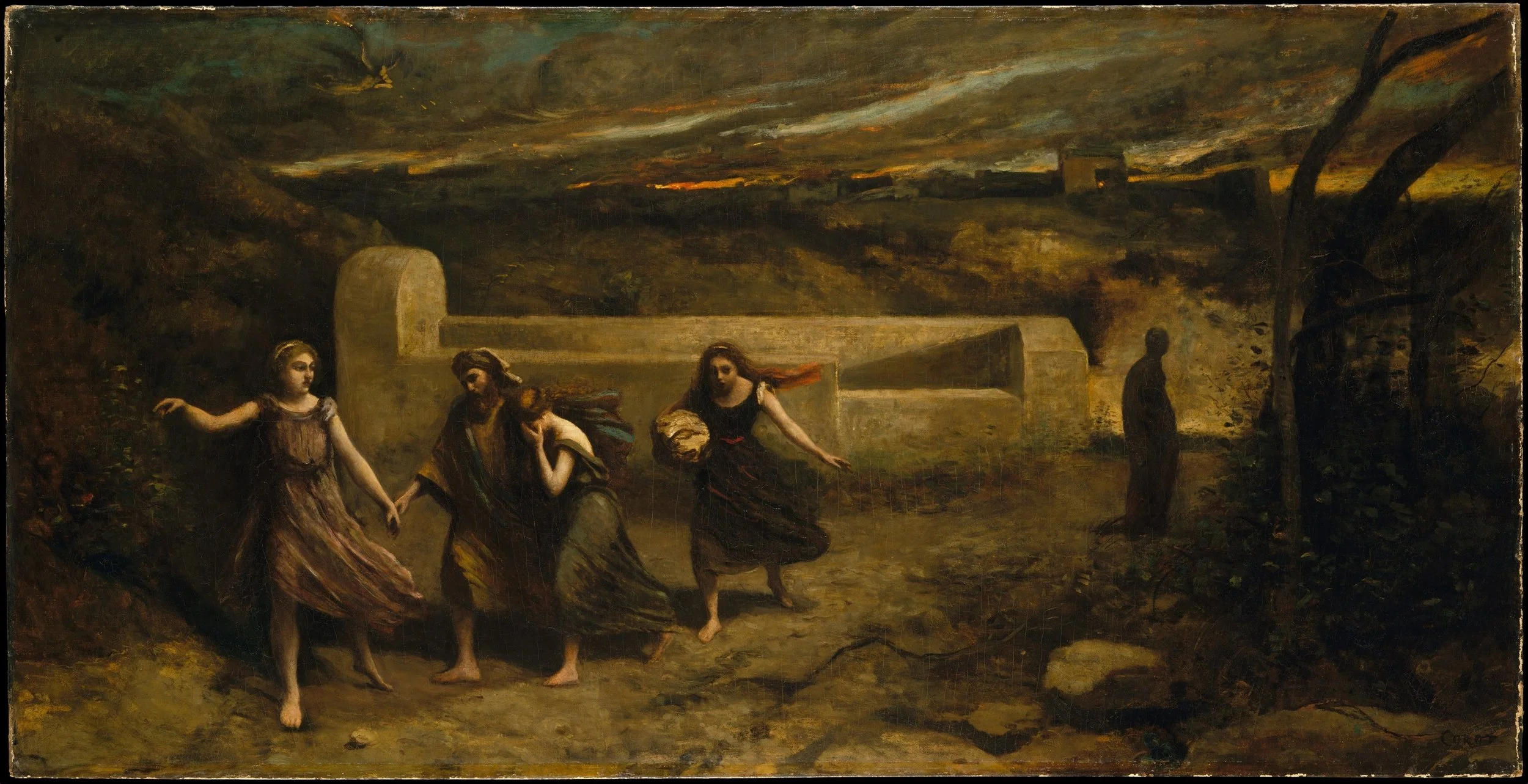
Jean-Baptiste-Camille Corot, The Burning of Sodom, 1843 and 1857, Oil on canvas, 36 3/8 x 71 3/8 inches
Corot’s The Burning of Sodom is an ugly painting composed of a spectrum of browns applied in blotchy brushstrokes (even the fire on the horizon burns a dull sienna). The painting depicts four graceless figures traveling toward the left side of a landscape weighed down by a stone structure, while a lone silhouetted figure to the right gazes at the burning city behind. Although it’s quite large, it’s easy to walk past on a visit to the Met. And even if someone were to notice it, none of their fellow museum goers would judge them if they turned away in favor of the museum’s more pleasurable fare—say, the Van Goghs or Renoirs or Degas, dozens of which, with their vivid colors and dappled light, are just a few steps in the other direction.
But there is something about this painting—perhaps its very ugliness—that attracted me, at least, like a moth to a flame, as if the depicted fire might provide warmth in the over-air-conditioned museum.
If I’d looked at the plaque before looking at the painting, it would’ve informed me:
This Old Testament scene shows an angel in the sky hurling fire and brimstone down upon Sodom, to destroy the city for its wickedness. At the left, another angel leads Lot and his two daughters to safety. Behind them, Lot's wife, who looked back in regret despite a warning, has become a pillar of salt.
But I never read the plaque before looking at a painting, if ever. Looking at a painting—really looking—starts with the faith that I am equipped to see the painting myself and, conversely, that it contains everything necessary to be seen. Any additional information (historical, biographical, economic, etc.) might augment my experience of it, maybe even change it (maybe), but only after I myself actually see it. Visual art is visual, and if I don’t spend the time to see it with my own eyes, I may as well walk from plaque to plaque, as many cultural consumers do, merely reading or, confoundingly, taking pictures of the plaques without looking at the works they refer to.
Imagine I hadn't known the story of Sodom and Gomorrah, or hadn't realized this painting depicts it. (Whether a painting can depict a story at all is a bone I’ll have to pick another time.) By simply looking at the painting before me—by noting what I saw and relating those things to its other aspects—I nonetheless would have seen a group of people fleeing a world in crisis that burns behind them. A woman leads the group, pointing off the canvas to the left. Two figures, an older man and a younger girl, follow, the man’s hand touching their guide’s, the girl’s covering her eyes. Behind them, a fourth figure, another young girl carrying a bundle under her arm, hesitates in the center of the painting, the momentum that might carry her leftward in the direction of the group counterbalanced by her arm that trails back in the direction of the city. And, finally, the fifth figure behind her, a frozen silhouette, turned back to gaze at the burning horizon. Above all of this land-bound drama, a winged figure flies in the upper left, hurling fire and brimstone.
Without the biblical story (which in Genesis is brief and lacks any narrative detail or psychological insight that would illuminate the behavior of the painted figures), it is clear from her composition that the central girl is torn between two choices: on the one hand, following the pointing figure, like the old man and the girl to the left; on the other, turning back to look at the burning city, like the silhouetted figure to her right. Depicted at the moment of this choice, she faces us, the viewers. When we stare back at her, it is as if we are looking at ourselves in a mirror; as if her crisis were our crisis; her choice, ours.
But what are her—our—choices in the face of this crisis? Where ought one to look? Where ought one to go? Whatever the guide directs us toward is beyond the edge of the canvas. She points to something we can't see or touch, somewhere we can’t enter because it’s not contained within the picture plane. It is immaterial as far as we viewers, outside the painting, are concerned, because it’s unpainted. We can, however, certainly see what we are leaving behind: a city aflame on the brink of destruction—or rather, we can’t certainly see it, as it teeters on the edge of destruction, nearly consumed by the flames and returned to the raw materials of ash and dust—or, better, we certainly can’t see it, as it teeters on the edge of abstraction. The depicted destruction loses representational intelligibility and returns to the raw material of paint. Ashes to ashes, dust to dust, paint to paint.
This understanding of the painting is confirmed if we introduce the biblical narrative that its title conjures. The guide is the angel leading Lot and his family away from the destruction of the wicked city of Sodom, down the metaphorical path of (the mercurial Old Testament) God, which is beyond the canvas edge, beyond the realm of sense and sight. They will be spared so long as they do not look behind them as their home burns. Lot and one of his daughters follow the angel, his eyes downturned, his daughter’s covered, their visual senses abandoned. The second daughter in the center—our mirror image—us—struggles with the choice to follow the angel or look back at the city. Her eyes, in shadow, might even be straining in this backward direction. Lot’s wife, the silhouette in the middle ground, looks back at the burning city, doing expressly what God commanded them not to do—commanded us not to do. But we—the viewers—look back as well. In turning to look at the painting—before we read the plaque, before we recognize the figures or the biblical narrative—we have already broken God’s commandment. We are not the middle daughter, choosing between the ideal and the earthly. We are Lot’s wife, who, because she turned around to look at the landscape aflame, was destroyed. We ought not to look, but we do, we already have.
This painting, a piece of visual art, is not meant to be looked at. Not merely meant to be looked at, that is. Paradoxically, in looking we learn that we ought not to look. We should not lose ourselves in the pleasure that oil paint occasions, nor in the illusions it conjures with its mimetic powers. The painting’s ugliness, its muddy color and stodgy application, is a testament to this. It is a material object that belongs to a material world flawed and aflame, burning in its wickedness. The foremost figure, the most un-angelic-looking angel, points off the painting, beyond its material existence to what can't be represented.
Belief in what lies beyond the physical plane may have been possible for Corot and his contemporaries. I, however, lack Lot’s faith to make that leap in the direction of the angel’s finger, off the edge of the canvas toward the immaterial. My gaze follows her gesture, but all I see beyond its edge is the wall that the painting hangs on—a wall made of plaster and covered in housepaint; a wall that I can see and, unlike the walls of the structure in the painting, can touch; a wall that I could set fire to—real fire. The angel may have pointed toward the divine in Corot’s time (or perhaps his focus on the doubting girl suggests it was already lost then), but today, she points only toward the idea of the ideal, across a gulf too wide to leap. Physically, she points away from a depicted world aflame, toward an actual world aflame.
Our world burns, yes. But, having looked, having faithfully stood in front of this painting for hours, jostled out of the way by museum customers taking pictures of the plaque, I see a bit clearer. This painting of Sodom’s destruction is not a distraction from our world in crisis, nor is it reassurance of a better beyond. It shows us the choice between turning away and seeing. It reveals to us our fate today, our inability to either leap forward into an unknown future or to turn back to a familiar past. It doesn’t show us a way out. It reflects us back to ourselves, not mimetically, but spiritually. Perhaps this is all that art has ever done.
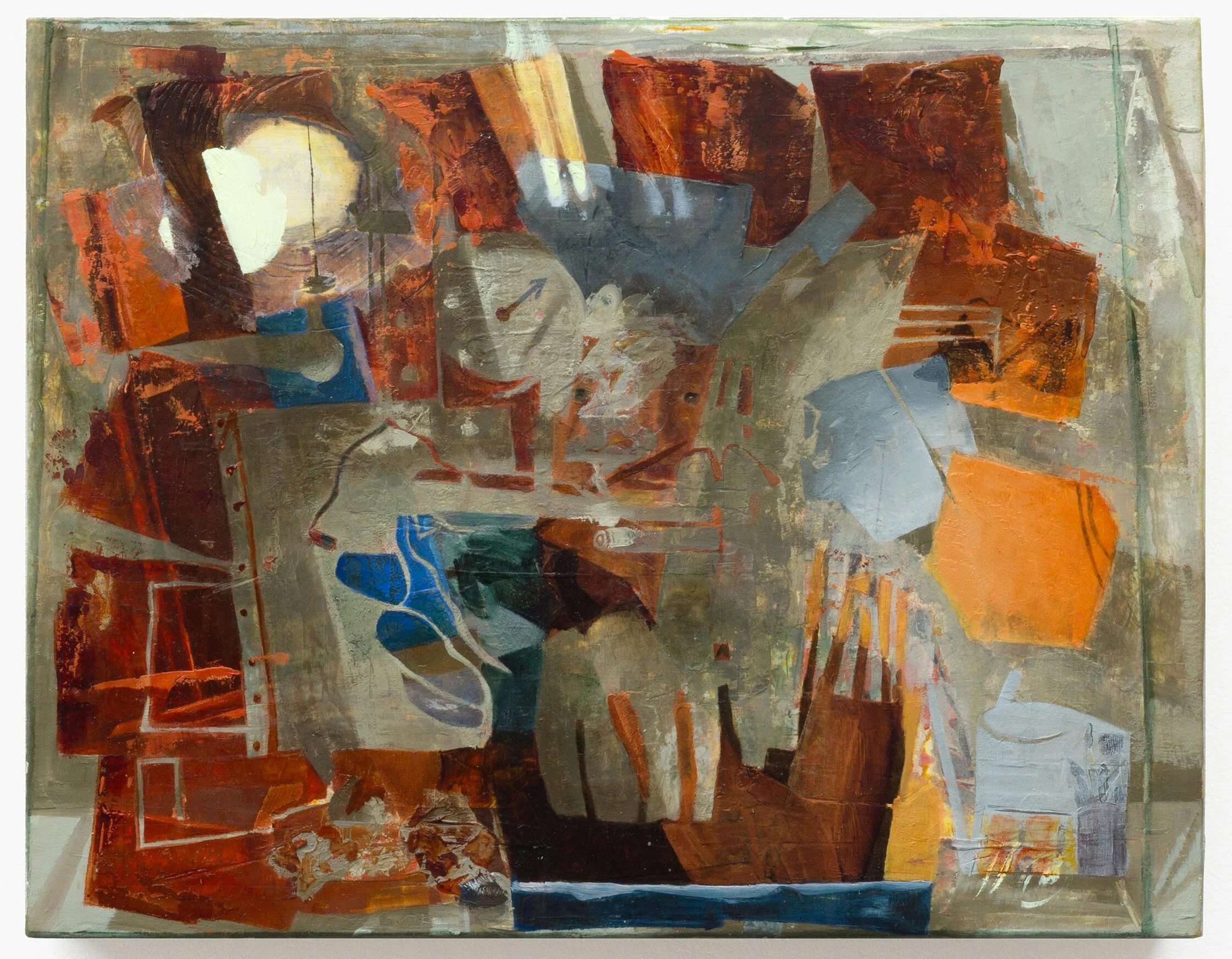
Anna Gregor, The Studio, 2025, RSG Gesso, egg tempera, shellac, oil paint, on muslin on panel. 9 3/4 x 7 5/8 inches
Anna Gregor is a painter and occasional writer about Paintings. She has a BFA from Parsons and an MFA from Hunter. She has exhibited in three solo shows, including "Double Space" at D.D.D.D. (2024), and various group exhibitions. Her essays have been published in Caesura Magazine, Two Coats of Paint, and The Revenant Quarterly.