
Matthew Sepielli on George Copeland Ault
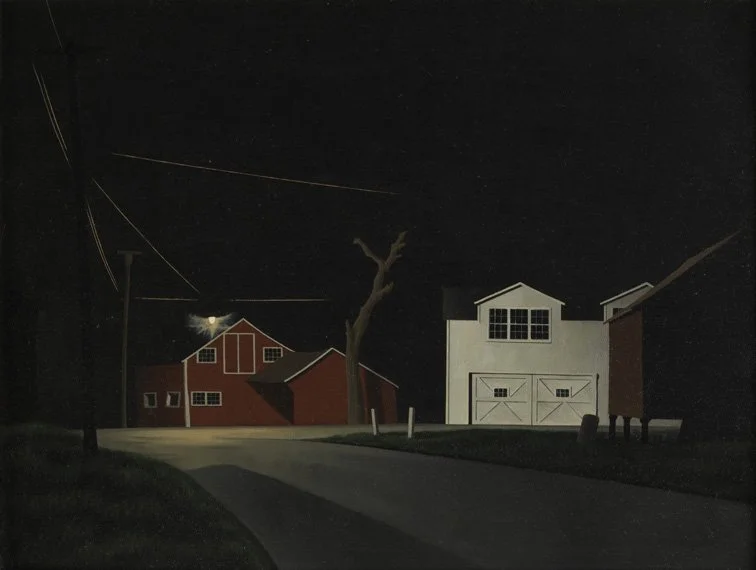
George Copeland Ault, Black Night: Russell’s Corners, 1943, Oil on Canvas, 18” x 24 1/6”. Courtesy of The Pennsylvania Academy of Fine Arts, Philadelphia, PA
A poem published by Alfred Houseman in 1922 contains the line, “I, a stranger and afraid, in a world I never made.” In his book, To Make a World, Alexander Nemerov notes these words had a particular impact on the painter George Ault. In his painting Black Night: Russell’s Corners, we see Ault’s solution to his alienation through his depiction of a place he returned to numerous times over the course of his career. It’s a nighttime street scene showing barns, bare trees, power lines and an intense, sharp light source. While this painting depicts the everyday, it is clear the painter saw the need to inject the magical, the speculative, and the uncanny into his work by altering specific elements, as if to bridge the world he lived in physically with the world he lived in mentally.
Russell’s Corners is a site located not far from Ault’s Woodstock, NY studio on Byrdcliffe Road that still looks much like it did when he painted it. The buildings still stand there (though some have been repurposed from barns into luxury houses) and the surrounding landscape is still largely composed of fields, woods, and open space. In his painting, Ault doesn’t add anything tangible to Russell’s Corners; he adjusts existing elements of the buildings and landscape to suggest that what we are viewing may be different than it appears.
Examine, for instance, the red barn on the left side of the painting. When you first look at this building it seems to be painted in a plain, flat, angular manner. Now, look a little closer; the windows on the side of the building are painted at slight angles, making them appear as if they are falling in and out of the exterior wall. Another window on the top left of the façade is completely cut through the frame and glass by the roof line of the building. It is clear that Ault painted with great care and precision, so why then are these elements off kilter? Because he wanted them to be.
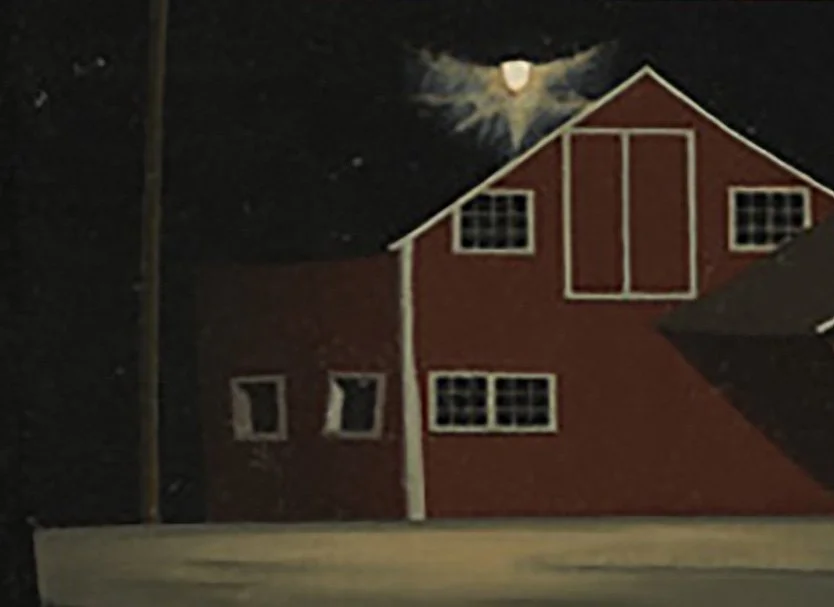
Windows depicted on the left side of the painting.
On the right side of the painting is a white clapboard building with pitch black windows. This building lacks most indicators of linear perspective and the even, shiny black of the windows is the same as the black of the sky that surrounds the scene-- locking these forms into place as if they are set in resin. The white building then becomes totally flat as if it is a painting of a stage set, propped up by supports in the back but lacking any interior. A re-presentation of a representation. Again, it is clear Ault knew how to depict things in a more conventional manner. (Look to the building at the far right of the painting which is painted with almost overly accurate perspective.) This is another instance of Ault bridging the space between his interior and exterior world.
And then, the black of the painting is impossible to ignore. It is shiny, solid and opaque and seems to freeze the forms of the scene into place. Across the surface of the work are sporadic power lines that appear more incised into solid mass than dangling in open, airy sky. In tandem with this, the entire work is lit by a light source that seems to suggest an impending arrival from the dark. It is this quality of the work in which Ault achieves one of the painting’s and one of Painting’s greatest potentials; the ability to capture energy and tension in a fundamentally still form.
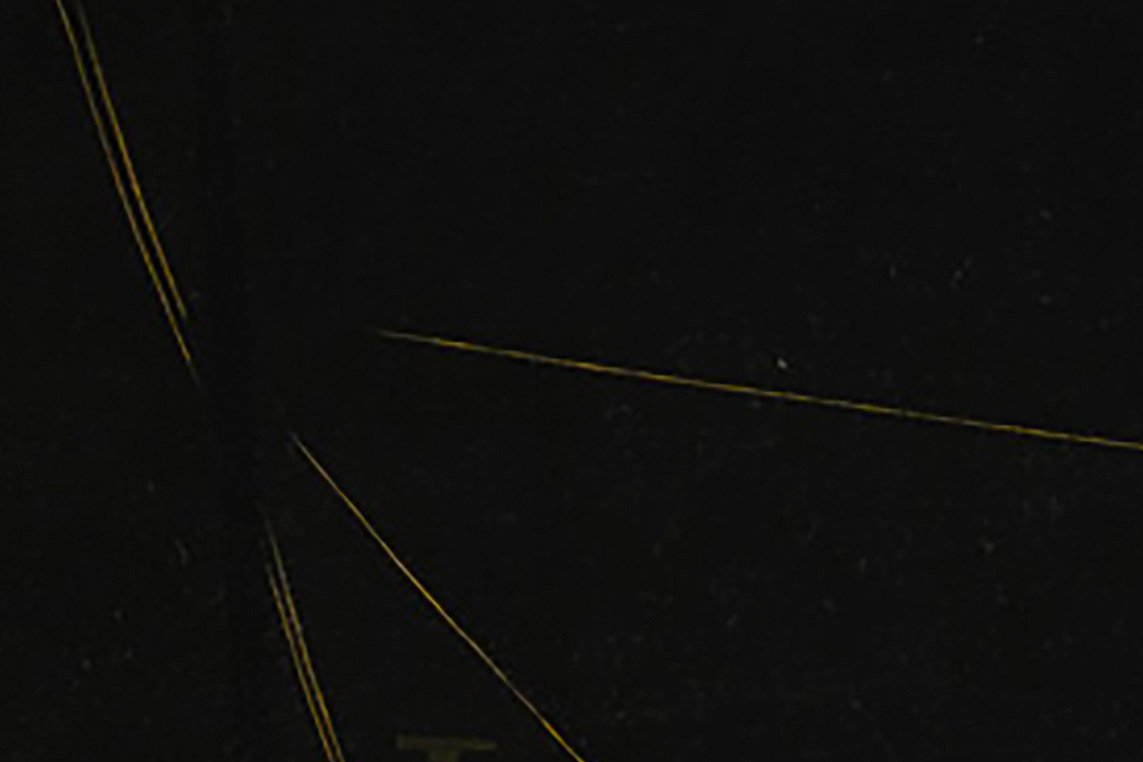
Powerlines cutting through the surface of the painting.
In a horror movie, we are rarely as frightened when a monster finally arrives as we were in the tense, nervous moments just before it appears. The monster always comes, and we feel a certain type of relief as we are able to confront our fears. In a painting such as Black Night: Russell’s Corners, relief can never come. The painting’s frozen, dark stillness leaves us forever anticipating what may emerge from the night. We are perennially in a state of “just before.” Paintings can be highly powerful this way. Through a combination of what is shown and what is suggested in the paint and surface, painters can freeze potent time, creating works that don’t lose energy, but encapsulate it.
In my own paintings, such as the one below, Three Mile Green Shore, I am conscious of negotiating “The Given and The Chosen” conditions of the work, as the poet Ann Lauterbach has so aptly described them. The “given” conditions are what is present at the start of a painting and persist until its conclusion and the “chosen” conditions are what is brought to a work during execution. I want to make paintings that are more than the sum of their material parts. When the given and chosen conditions churn together, I get a sense that this is possible. For Ault’s painting, the given condition was the location of Russell’s Corners; the chosen condition was the way he painted it. The depiction of Russell’s Corners that emerged is both familiar and otherworldly. George Ault pushed the everyday, bridging his inner and outer worlds into an amalgamation of the observable and the hidden.
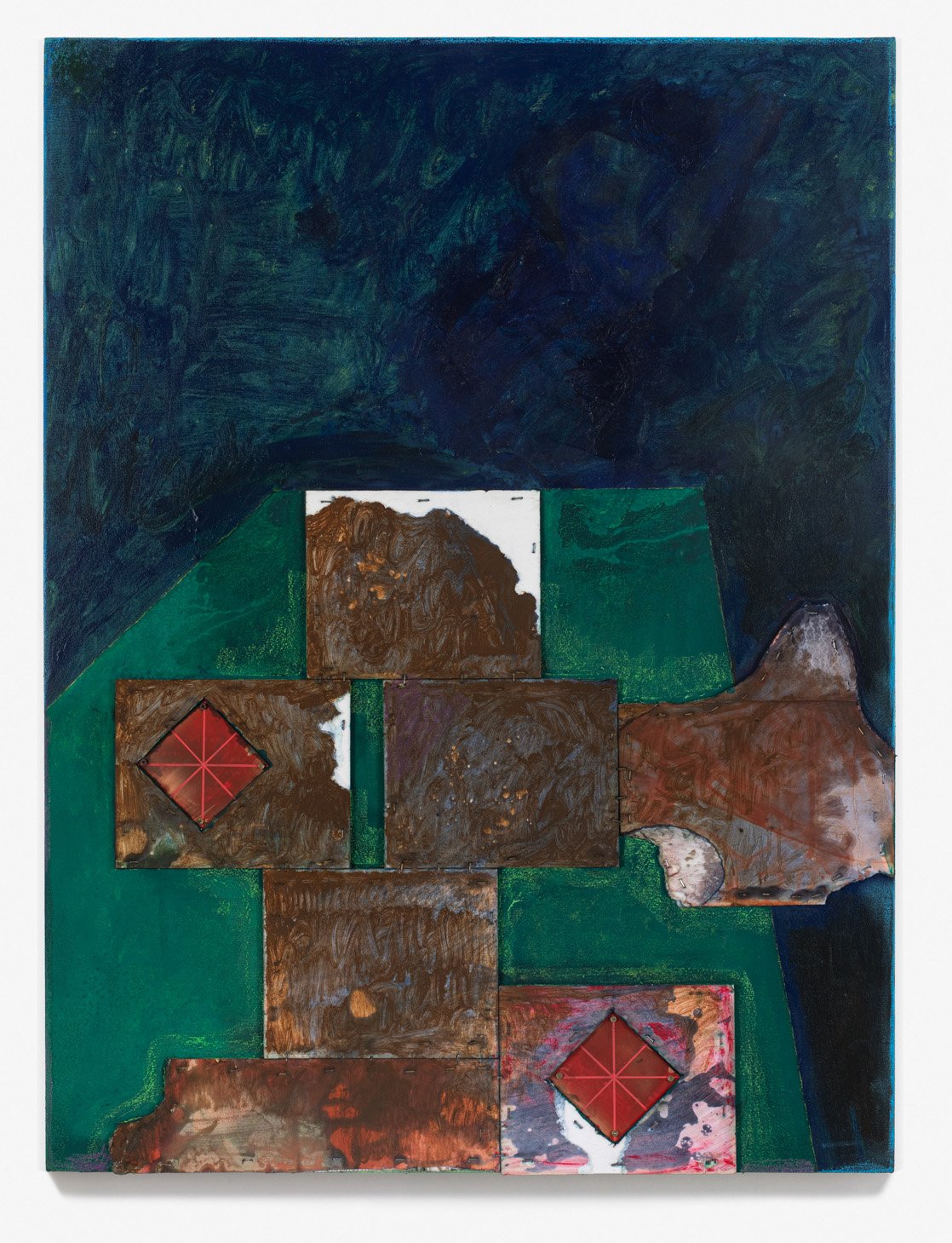
Matthew Sepielli, Three Mile Green Shore, 2025, Oil, Foam Core, Casein and Enamel on Canvas over Panel, 36” x 48”. Courtesy of the artist.
Matthew Sepielli is a painter who lives and works in Southeastern Pennsylvania. He holds a BFA from Tyler School of Art and an MFA from Bard College; both in painting. His most recent exhibition, “The Strange Bird Whose Nest I Am In” took place at The Painting Center in New York City in September 2025. Sepielli is an Associate Professor of Studio Art at Delaware County Community College.