
Natania Rosenfeld on Robert Lucy’s Paradise Drawings
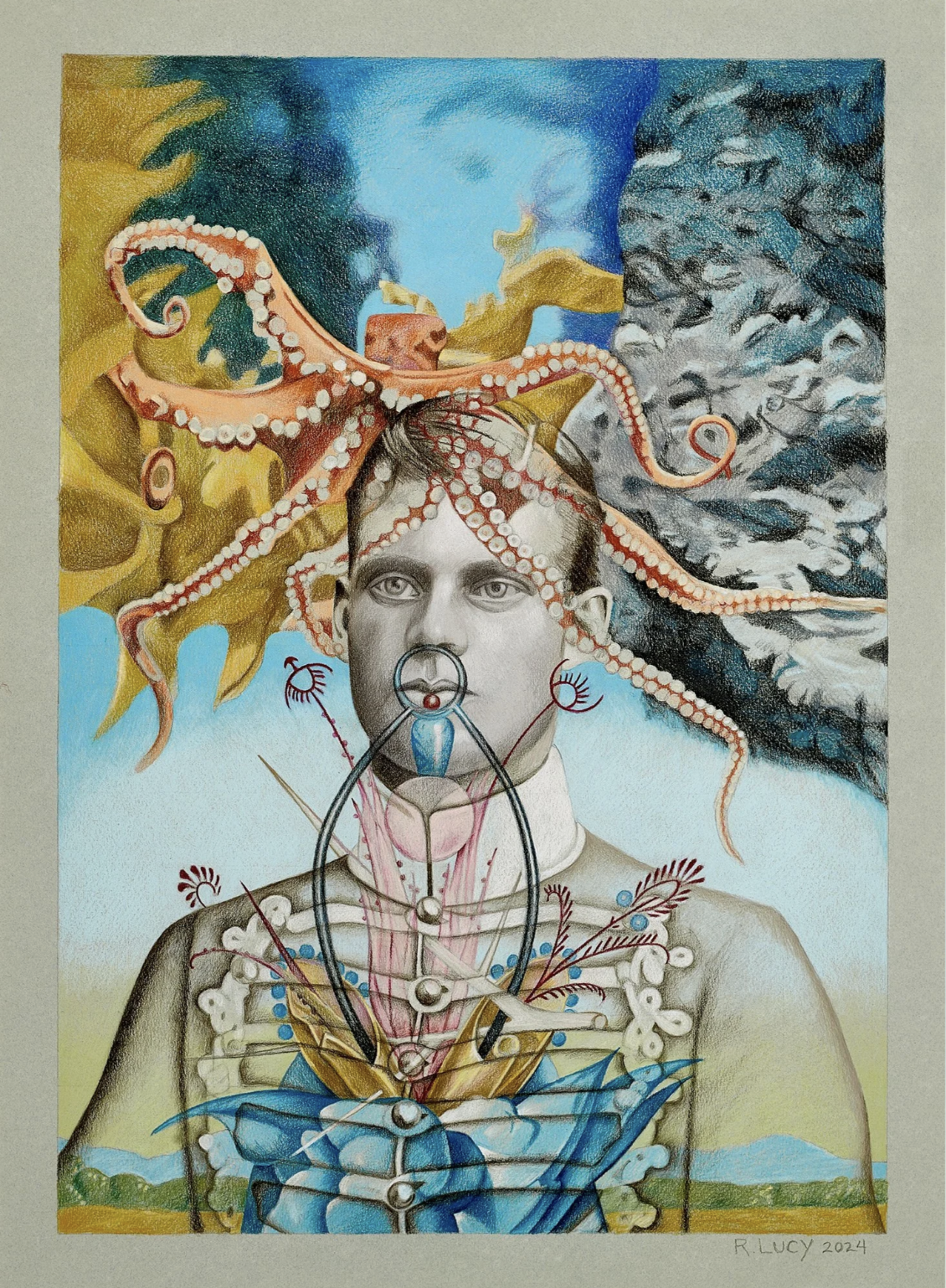
Robert Lucy, Rani, 2024, Colored pencil on colored paper, 22 x 16 inches
Exhibition: Robert Lucy, Paradise, Kentler Gallery, February 14 – March 29, 2026
Although I had strong impressions and thoughts immediately after circling Kentler Gallery, it took me some time to put all but one into words. That one was: Robert Lucy does for obscure gay men what Judy Chicago, in The Dinner Party, does for famous women. I had seen The Dinner Party somewhat recently, and it held up; there’d been nothing quite like it before, and I hadn’t seen anything analogous since. Now I was seeing something that, if not analogous, connected.
But of course, Paradise is a quite different project. The Dinner Party both frees women from and re-binds them to old images of femininity, above all, flowers and fruit (think Eve and the apple). Paradise connects gay men to floridity, a longstanding association, but also liberates these particular men by countering the rigidity of their postures, enforced by the conventions of early portrait photography in conjunction with those of masculinity, with the sprawling, twisting fecundity of their emblematic flora and fauna. Trapped in earnest uprightness, these beautiful fellas seem almost deadened, though in many cases a tiny smile hints at hidden exuberance. Lucy animates them (think God and Adam?) in these drawings that marry discipline with lavishness. Discipline: the line, the carefully selected color schemes for each; and the time! Just the time each one must have taken, far longer than the long photography sessions.
Imagine these men walking into a room with their emblemata fully intact. Assuming the room held a cross section of contemporary Americans, half would perceive monsters, recoil in fear, then outrage, possibly succeeded by violence; half would be intrigued, even, perhaps, delighted. (I base this proportion on recent elections, though we are often reminded that only 30+% voted for our monstrous regime, and of those 30%, not all are homophobes and misogynists.) From heterogeneity another question arises, that of hybridity. If it’s possible to be a member of either sex, of neither, or of both, is it possible to also be part-plant, bird, or sea creature? The writer Philip Hoare (William Blake and the Sea-Monsters of Love, The Whale, The Sea Inside, Albert and the Whale) thinks we are all sea creatures.
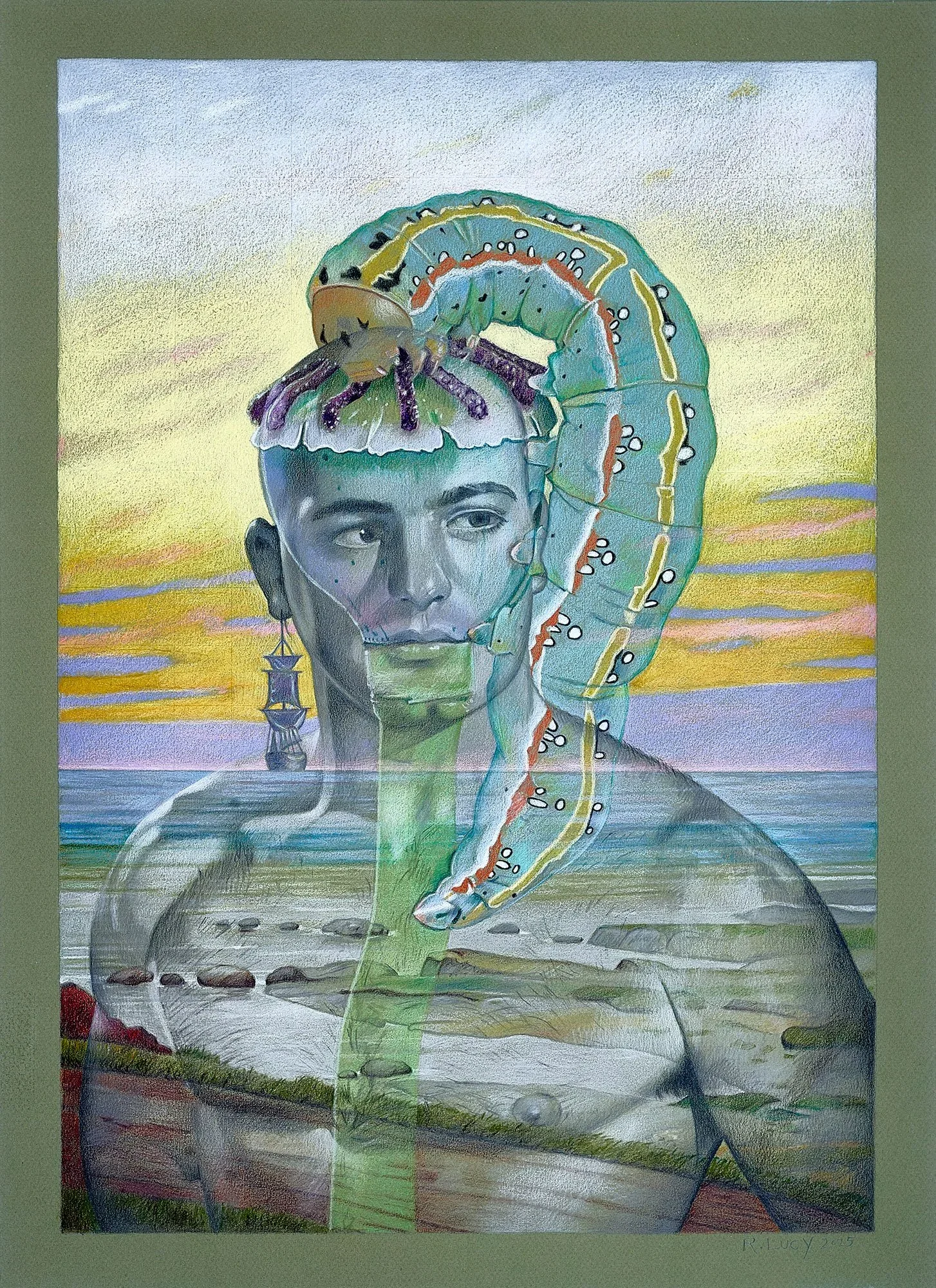
Robert Lucy, Tattoo, 2025, Colored pencil on colored paper, 22 x 16 inches
My favorite of these exotic beings (though truly, I can’t choose) is a man with a body-builder’s chest, in a rare modern photo from the 1950s, and a giant caterpillar as headwear. Perhaps it is the man’s expression: dreamy and benignant, looking off to the side (let us remember that “queer” once meant “to put out of order,” as in off-kilter, and even earlier, to question). He seems perfectly capable of bearing his over-large familiar, who might also be some sort of sea-worm, as the sea stands stilly behind him, and enters his beach body, and a tall ship hangs from one ear like bling. Something green and semi-transparent is pouring down from the top of his head, where a large sand-dollar rests snugly like a beanie, or a kippah on this very Aryan head.
Our responses to portraits are always subjective. Perhaps this Venus rising from the sea comforts me because he was young and on the beach at the same time as my late father. Back in the day, my father and his two brothers waited tables in Atlantic City, and I have a black-and-white photo of them near the boardwalk, three slender, half-naked first-generation Jewish boys just breaking from the chrysalis.
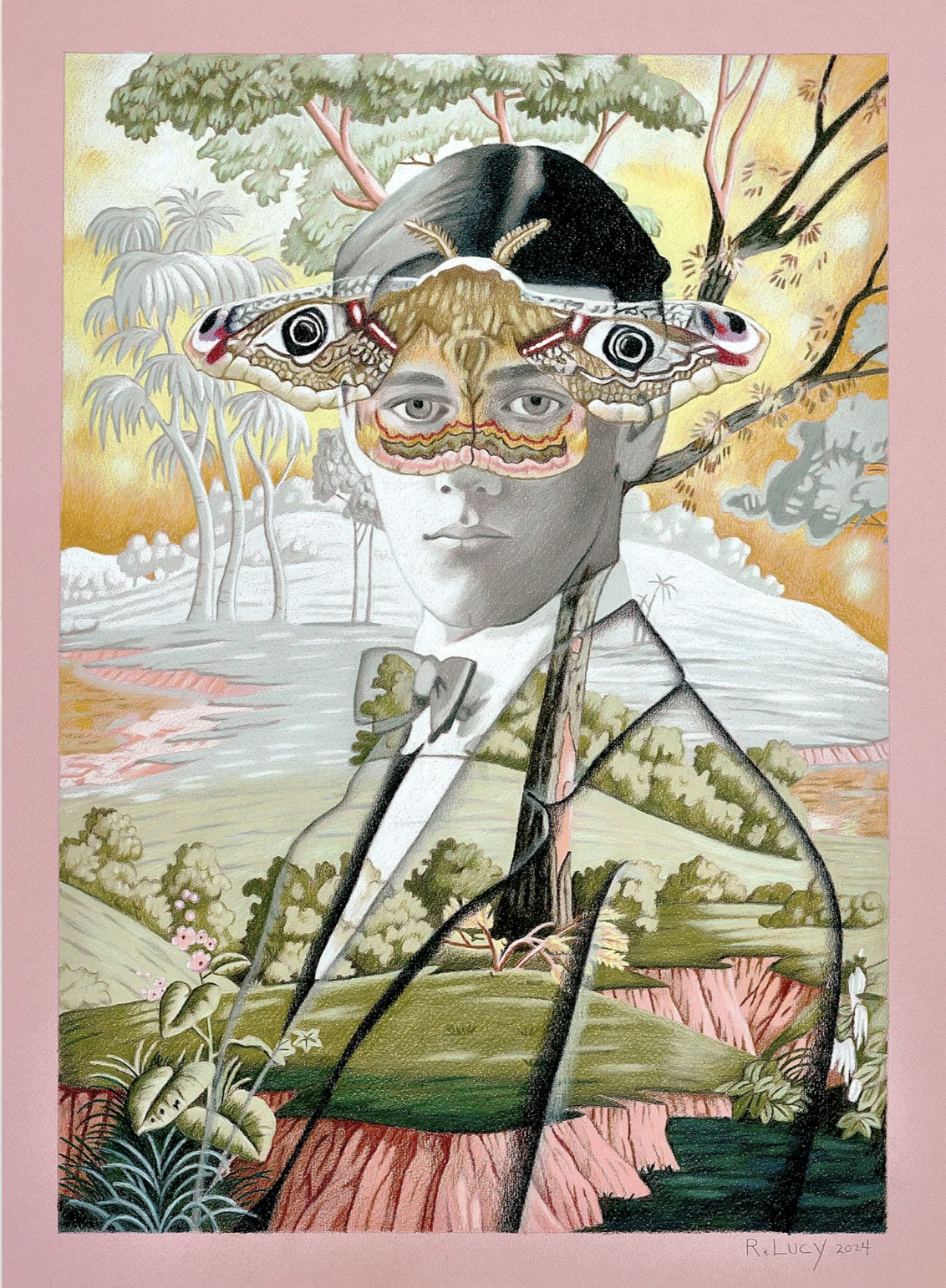
Robert Lucy, Camouflage, 2024, Colored pencil on colored paper, 22 x 16 inches
The late-Victorian young men worry me, tightly encased, delicate of feature, already or about to be thrust in uniform for some late nineteenth-century war or police action. I have just been reading about Oscar Wilde’s trial and imprisonment. We are in a parlous moment; the Atlantic speaks of “the new homophobia,” born of “the strange state of straight men.” (Case in point: the husband of a particularly odious, recently fired cabinet member was caught on camera sporting huge fake mammaries.) These people don’t know who they are or what they want, and so they plump for parody and vilification. One of the many remarkable things about Lucy’s drawings is that they could so easily be parodic—or for that matter, sentimental—but aren’t. Such a long time we, non-Indigenous Westerners, have taken to re-comprehend the hybridity of the human animal, the desire and capacity to shapeshift, and our own place in the biosphere. Now come these bloated paragons of hypermasculinity, these ministers of war, some of them given to displays of their own torsos covered in evil emblems, to close it all down. Those tattoos show nothing organic, nothing representative of growth or evolution; the only thing being signaled is a stiffened hate.
Someone needs to save us from these men. Perhaps Robert Lucy can.
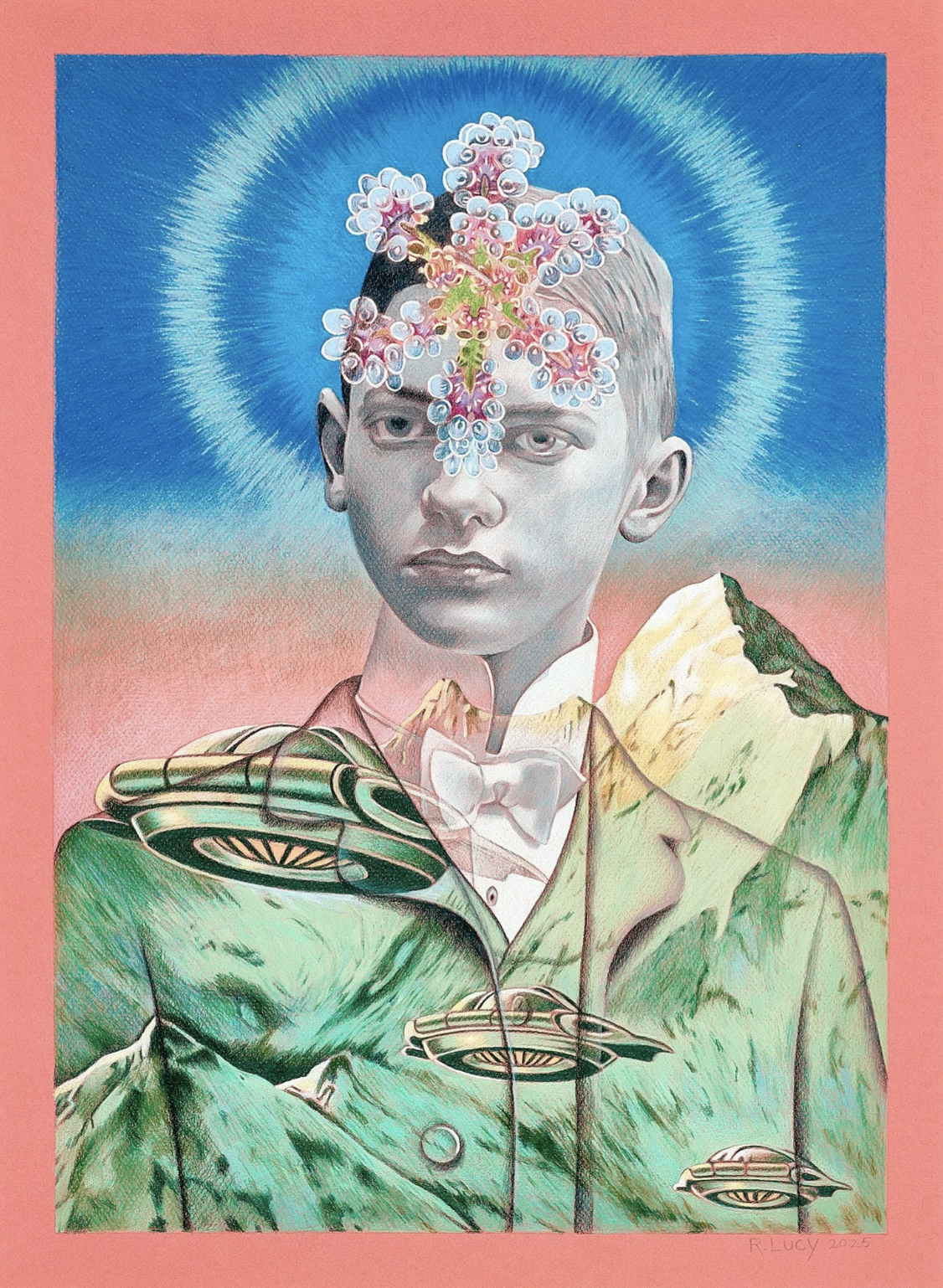
Robert Lucy, Star Man, 2025, Colored pencil on colored paper, 22 x 16 inches
Natania Rosenfeld is a writer, independent scholar and former Professor of English (Knox College, 1998-2018). She has published two books of poetry, The Blue Bed (Spuyten Duyvil Press 2021) and Wild Domestic (Sheep Meadow Press 2015), as well as a scholarly book, Outsiders Together: Virginia and Leonard Woolf (Princeton 2000). Her essays, poems and fiction have appeared in journals including The Hudson Review, AGNI, The Yale Review, APR, Raritan, Gettysburg Review, and Michigan Quarterly Review.
Ambiguous Acrobat
By Natania Rosenfeld
She’d been a gift at my parents’ sudden wedding.
Unheeding, they hung her above my bed.
Her white face and carmine lips afflicted me.
I feared what seemed twisted and angry.
Was it my mood or hers that made her change
from serene to tortured to smugly smiling?
Her lissome body, sheathed in pantaloons,
seemed caught between states, ready to shatter
in a mad dance. They, too, were trapped like that,
in the swing of their rage-love pendulum.
Her labile, plump mouth, eyes of anemone, could
turn hard, his delicate cheek, angled in attention,
grim. Defiant, I danced my own tarantella.
They cheered or shut me down.
I became a reader of faces and words.
Leaving home, I took their books but left the saltimbanque
behind. For years, I was her. One day, late indeed,
I vaulted from the frame and said Watch me.
Poem first published in Antiphony in 2024