
Henry Brown on Piet Mondrian
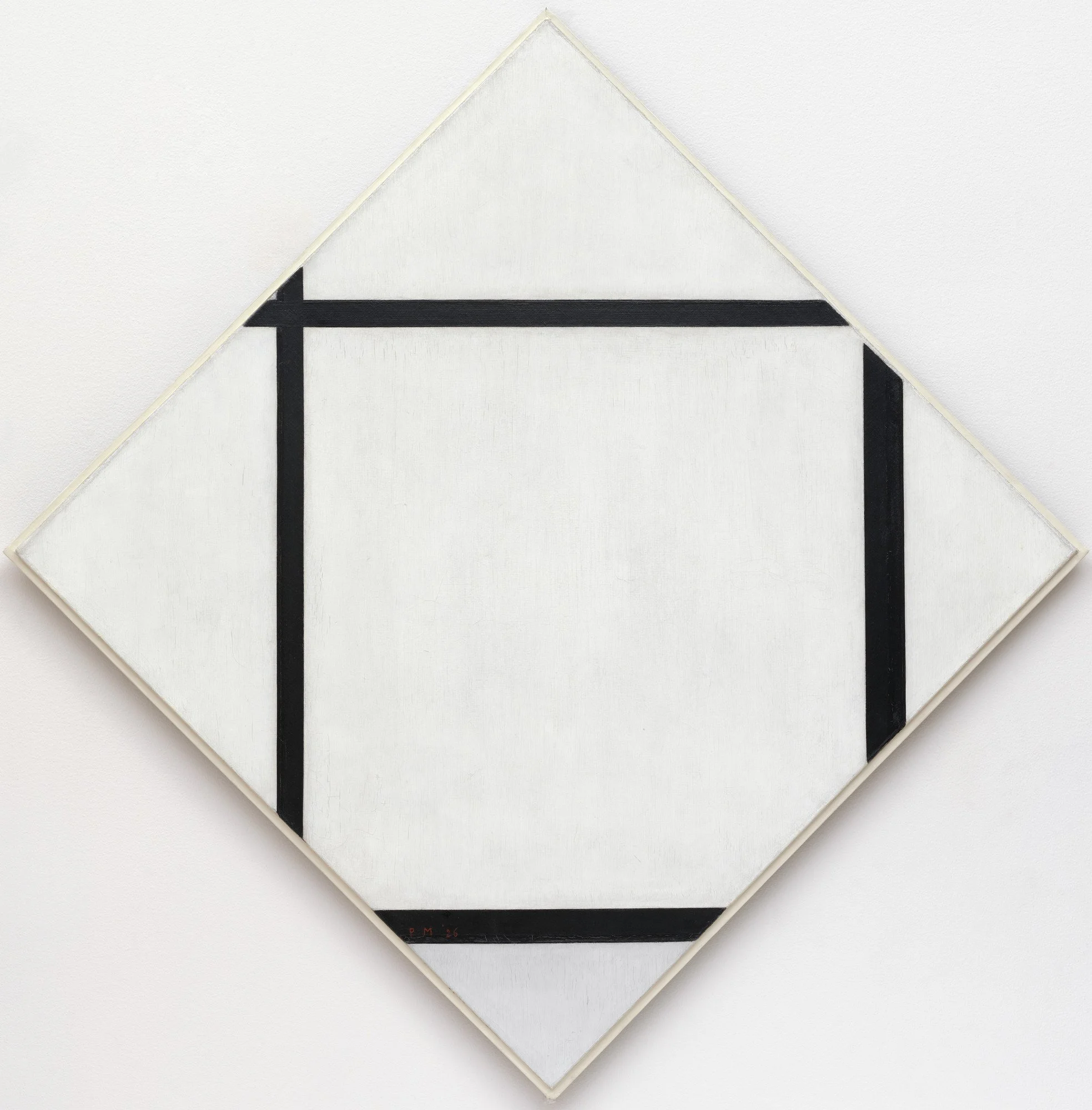
Piet Mondrian, Tableau I: Lozenge with Four Lines and Gray, 1926, Oil on canvas, 46 1/8 × 45 1/2 inches, Museum of Modern Art, New York
I recently participated in an exhibition about the grid: its literal systems, distortions, and deconstructions. That led me to revisit a reductive grid-based painting by Piet Mondrian on display in the permanent collection at the Museum of Modern Art. He titled it Tableau I: Lozenge with Four Lines and Gray, listing the limited number of pictorial elements in the work. A lozenge is a diamond shape and refers to the canvas. This abstraction seems simple, but the composition and use of space are complex. The Guggenheim Museum included a similar white painting in its 2024–25 “Collection in Focus” exhibit on Mondrian. I have always had an affinity for his interpretation of spatial relationships in these paintings.
At first, the painting reads like a cropped grid section. Closer observation reveals Mondrian’s deliberate manipulation of line, space, and corners. Two horizontal and two vertical black lines of different thicknesses form what appears to be part of a grid. These lines only intersect once, near the upper left side of the diamond-shaped canvas. The other intersections and projected corners of the central rectangular plane would lie past the painting’s edges if the lines continued. They end without intersecting at three of the edges. The unseen intersections and corners of the rectangle are implied, not depicted. The viewer visualizes the image from cues in the work, completing what isn’t there.
Literal interpretation of the painting dispels the illusion. The composition is painted on a flat surface with the lines and planes meeting the edges of the canvas. The black lines flank the triangular planes of different sizes in each corner. All of the planes in the painting are white except for the gray triangle in the bottom corner. Another tiny triangle sits at the middle of the upper-left side of the canvas, between the two intersecting lines. The plane in the center of the painting resembles a rectangle but lacks four right angles. It is seven-sided with only one right angle at its upper-left corner. The black lines abut the long sides and the diagonal edges of the canvas touch the short sides. Each plane here is a discrete shape. The specific distribution of these lines and planes across his painting surface creates balance in the asymmetrical composition.
Mondrian balances opposing spatial interpretations as well. These are unified in the painting itself, leaving the viewer to make perceptual choices in reading the work. I also combine contradictory spatial relationships in my paintings. I counter the flat static surface with pictorial space that is in flux. The white gessoed ground and compass-and-ruler underdrawings are left visible with the painted images on top. Although the surface of the work is fixed, the viewer’s perception causes it to advance and recede, creating depth. This activates the white ground, pushing it back in what appears to be a state of change. Both the fixed and changing states coexist in the work.
I look to Mondrian’s lozenge paintings as focal points for investigating space. They prompt us to examine our own processes of seeing, presenting possibilities and complexities beyond initial perception.
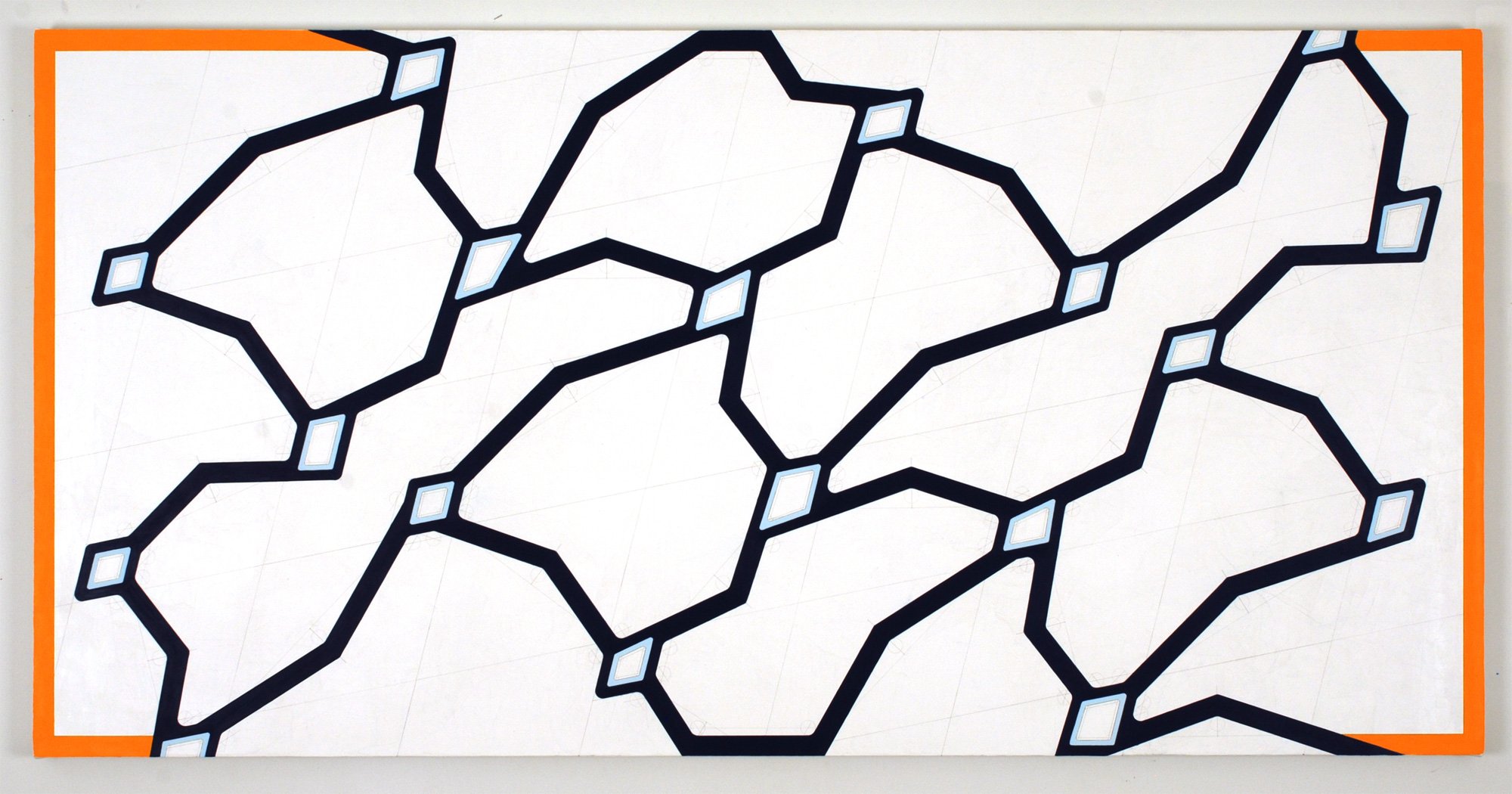
Henry Brown, Metamorphosis, 2025, acrylic, pencil, gesso on canvas, 36 in. x 72 inches
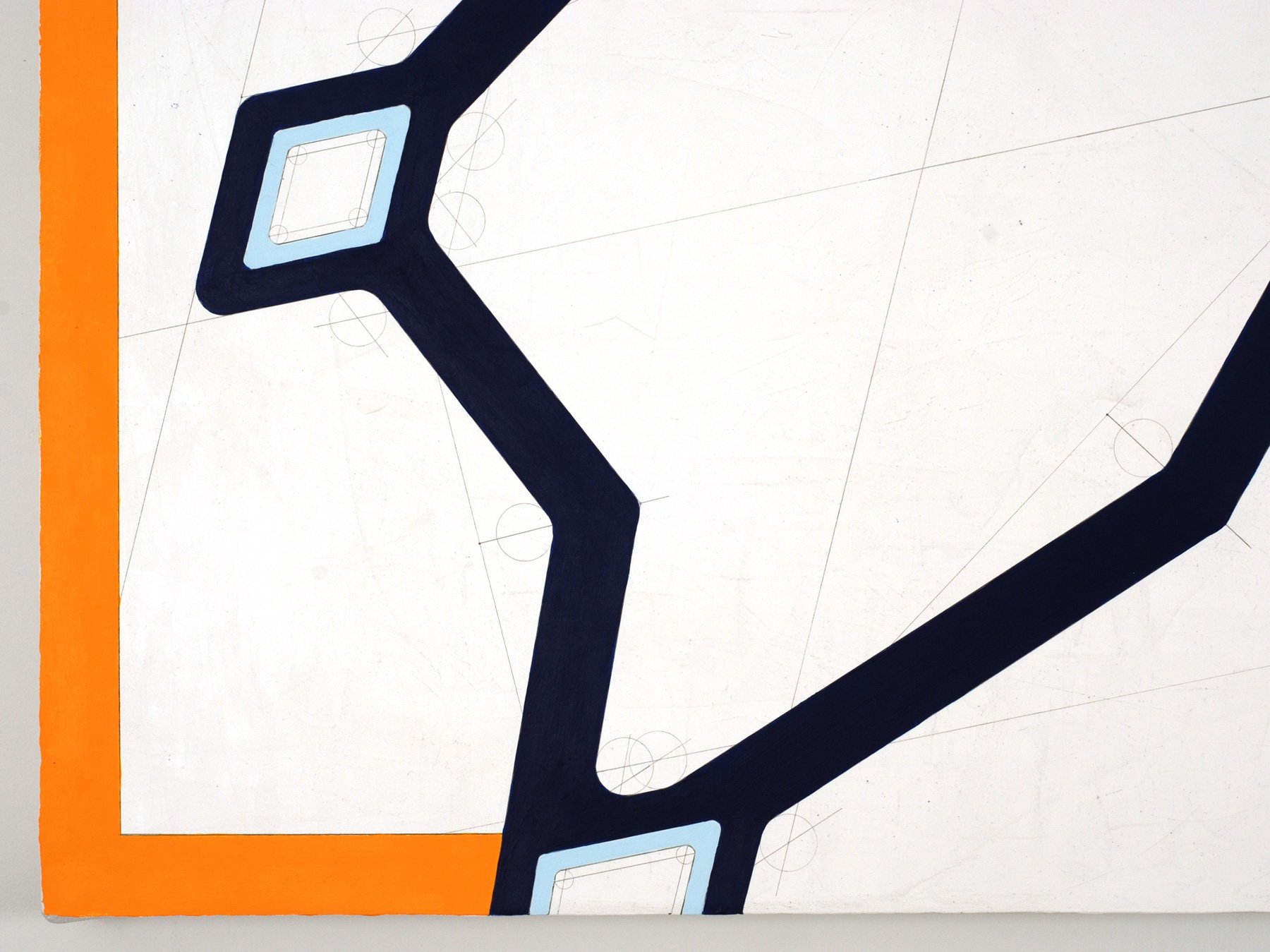
Henry Brown, Metamorphosis (Detail)
Henry Brown is an abstract painter based in New York City. He constructs geometric images from compass-and-ruler underdrawings that engage perception through changing spatial relationships.