
Dana Sherwood on Anna Gaskell and Saint Godelieve
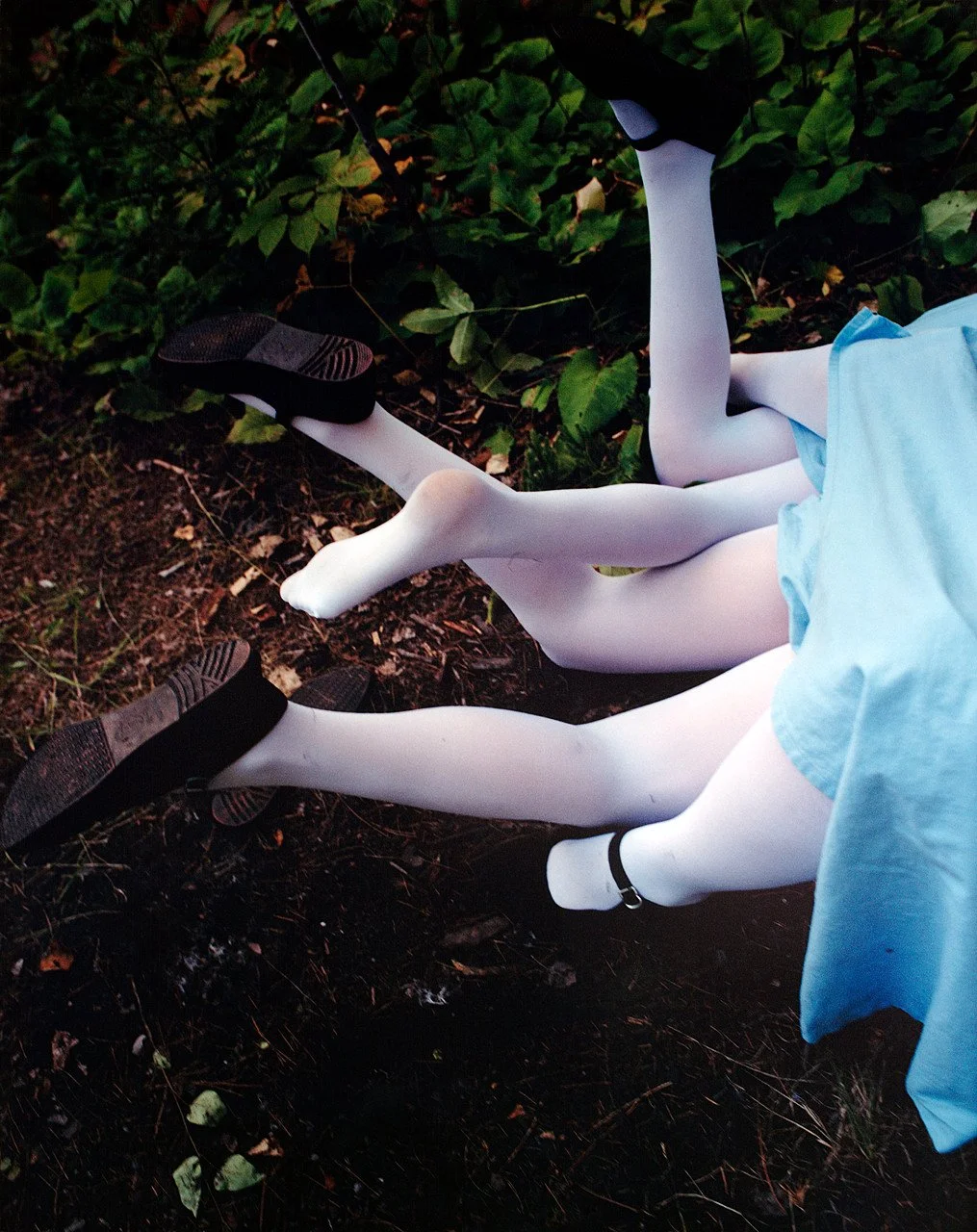
Anna Gaskell, Untitled #25 (Override), 1997, Chromogenic print, 19 7/8 x 15 1/2 inches
When I was a young art student in the south of France, we took a field trip to the Petit Palais, a museum of medieval and early Renaissance art in Avignon. On view was a large collection of small paintings on panel from the 13th to 15th centuries, and what felt like an overwhelming sea of religious iconography after what had already been a long day of museum-going. Back then, I didn’t have much patience for sightseeing, or maybe I just had no interest in spending hours looking at things that didn’t hold much appeal for my twenty-something-mind, such as religious painting. It was something ubiquitous from my childhood . Early on, art in churches was the only art I was exposed to. It seemed boring to me—certainly not exciting in the way contemporary art felt when I first discovered it.
Earlier that day, I had seen a gorgeous exhibition at the Collection Lambert by artist Anna Gaskell, At Sixes and Sevens. I loved the work and even bought a copy of the catalogue with my meagre, starvation-level student budget. Her photographs of young women in the forest, wearing white tights and pointy black Mary Janes and Alice-in-Wonderland-esque smock dresses, conducting themselves in mysterious ways, were entrancing.
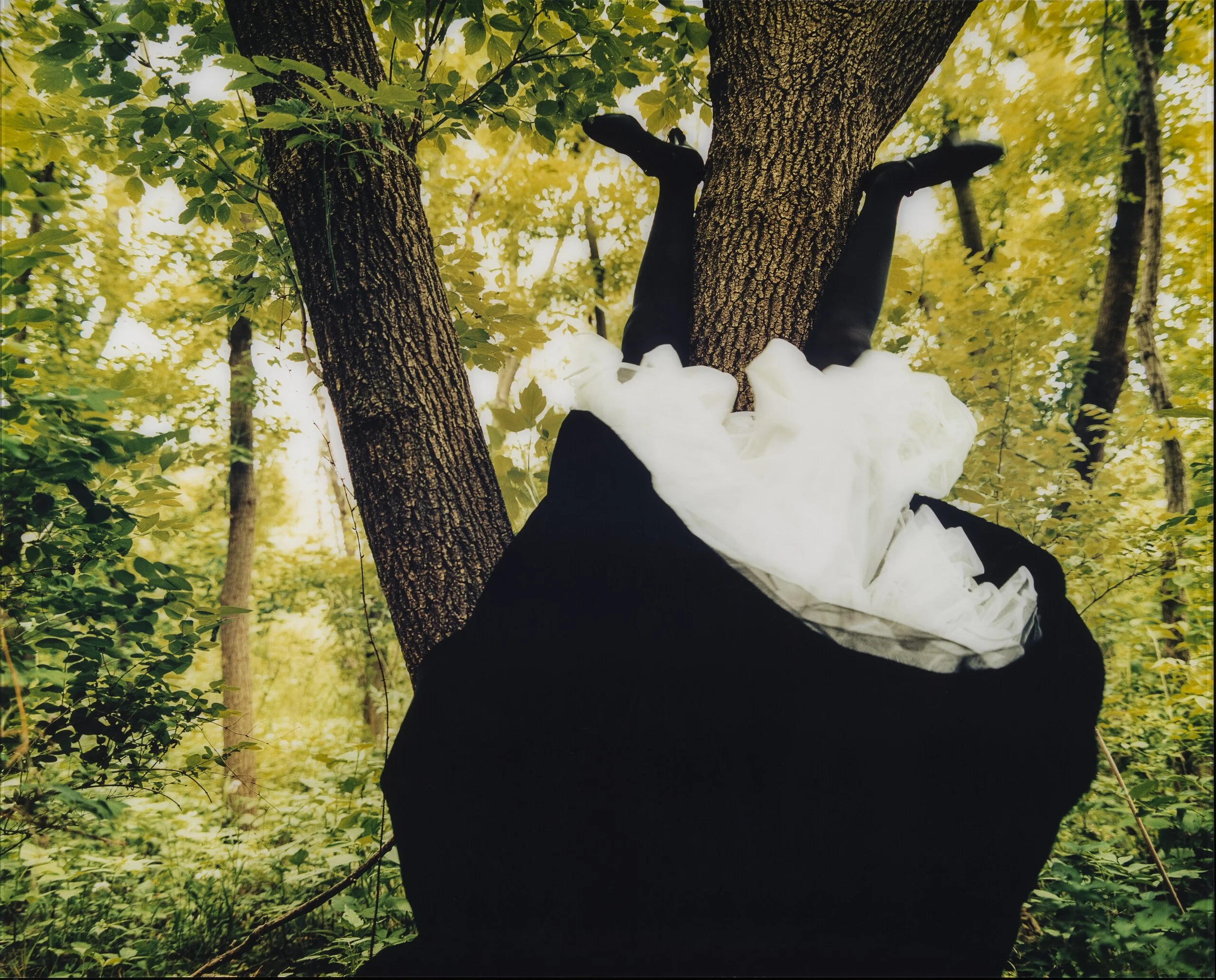
Anna Gaskell, Untitled #104 (A Short Story of Happenstance), 2003; Chromogenic color print, 71 ½ x 88 inches
By the time we arrived at the Petit Palais, I was tired and, still excited by what I had just seen, disappointed by the expanse of tiny religious paintings stretching before me. In hindsight, sometimes the best time to look at art is when you are tired. You move slowly and spend more time looking, sinking deep into each work. And looking—really looking, in an absent-minded, glazed-over stare at each tiny tempera panel—revealed to me a world I had not been able to see before.
Gaskell’s exuberant, vivid, large scale photographs were easy to enter, to feel, and to be overwhelmed by. But deep looking into the landscape and architecture of the tiny panels opened an expansiveness within each work that drew me in, like entering a wormhole. In the half-pleasurable trance of a hangover, I found myself transported to the Middle Ages through the porticos and castles, archways and terraces that frame the action of the paintings. Something magical happened: the architecture became a virtual entrance into a world of saints, angels, and virgins, where miracles and the supernatural came to life.
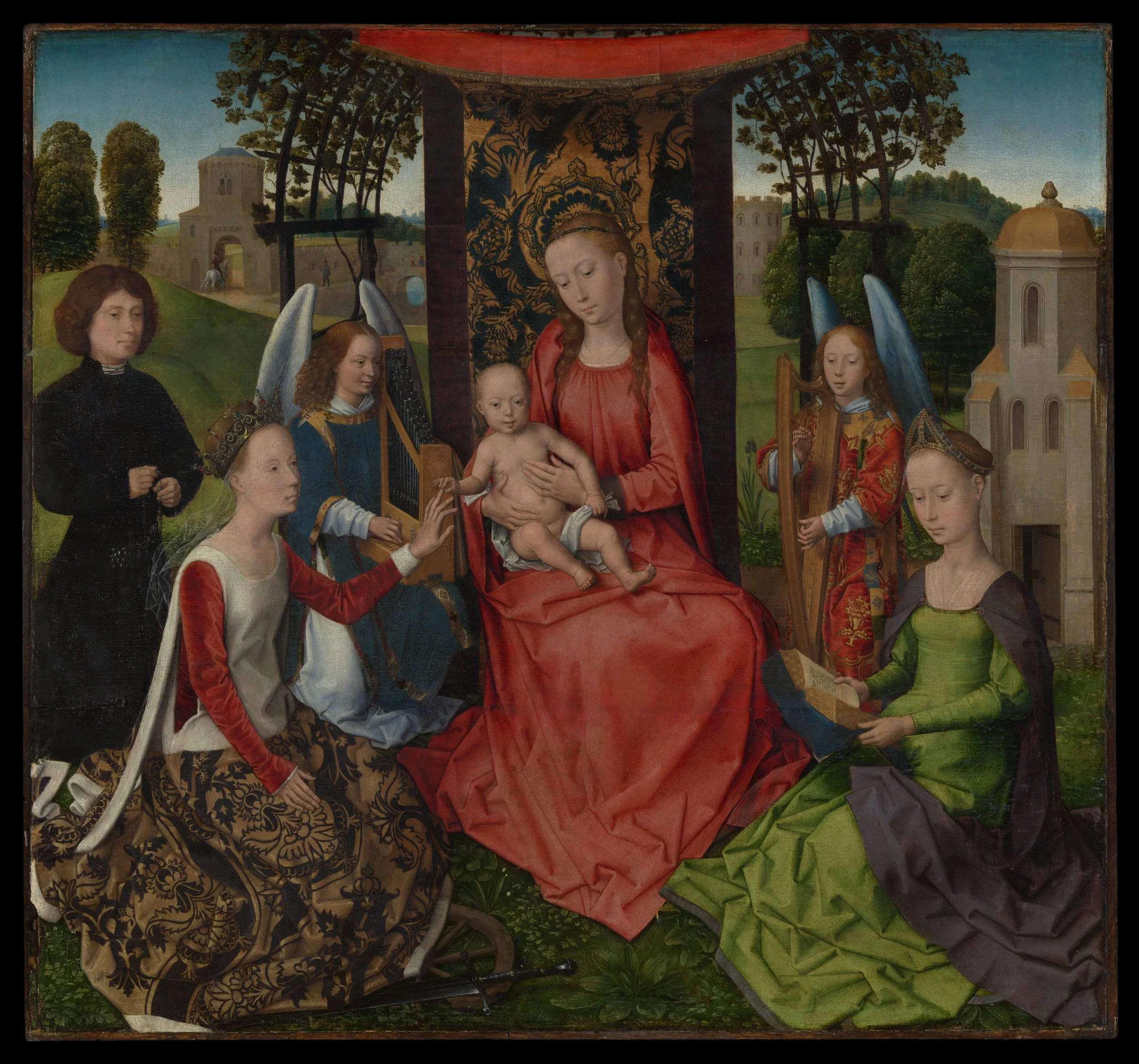
Hans Memling, Virgin and Child with Saints Catherine of Alexandria and Barbara, early 1480’s, Collection of the Met, oil on wood, 26 x 28 inches
I noticed for the first time subtleties in the landscape in which the artist had individually rendered every blade of grass, every strawberry, daisy, and dandelion. Hours could be spent simply examining the grassy meadow in the foreground. Once entranced under the spell of the landscape and architecture, the eye moves to the central action of the work: a coterie of saints, angels or the Virgin Mary peacefully suckling the baby Jesus at her breast. The body relaxes and breathes in resonance with them. A reverie takes hold.
In Anna Gaskell’s photographs, despite the fecund Eden in which the work is set, there is a darkness that is only hinted at. All is not as it appears. There is transgression afoot—it is palpable, though impossible to name decisively.
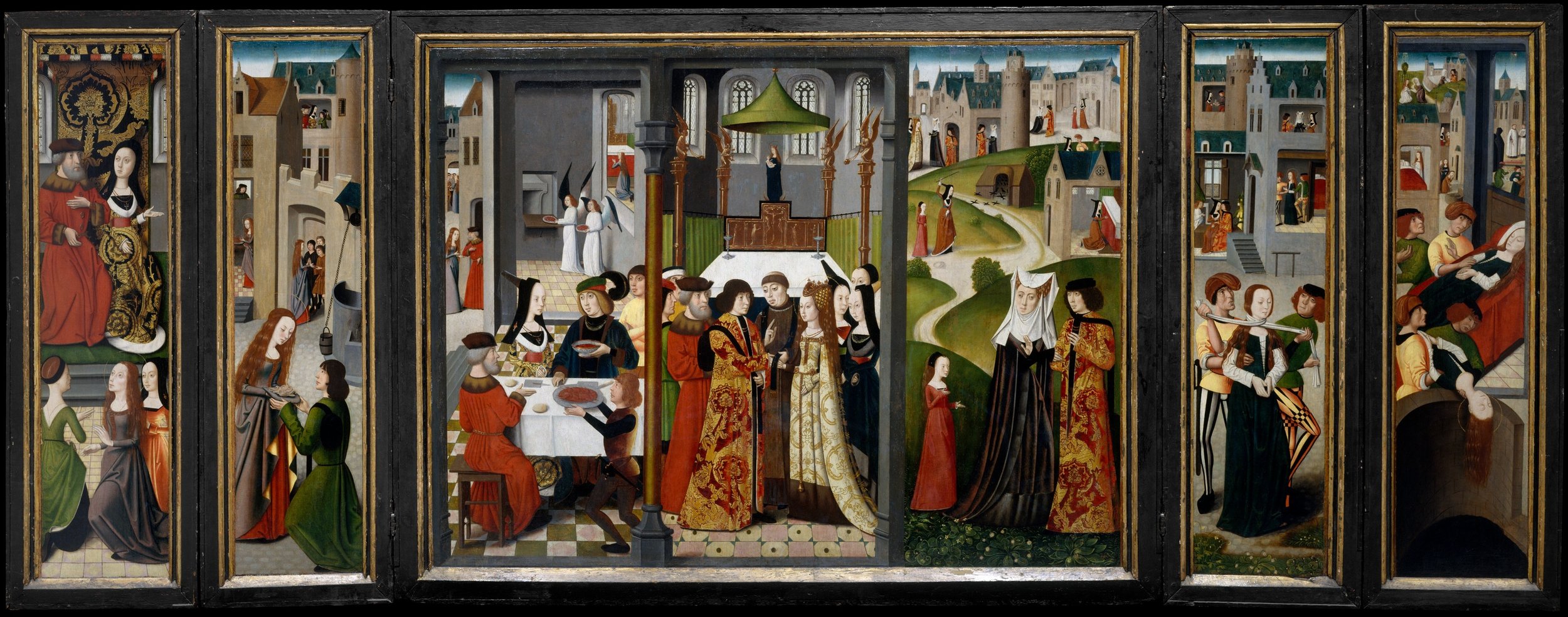
The Life and Miracles of Saint Godelieve, Master of the Saint Godelieve Legend, Oil on wood, Open 49 1/4 x 126 3/8 in. (125.1 x 311 cm); closed 49 1/4 x 63 1/4 inches
This quality of feeling also exists in certain early Renaissance paintings depicting the lives of saints. One such example, The Life and Miracles of Saint Godelieve, painted by the Master of Saint Godelieve and now in the collection of the Metropolitan Museum of Art, is a fully intact altarpiece commissioned by the Guild of Load Bearers in Bruges for their chapel in the Church of Our Lady. It dates to the late fifteenth century, though no precise year has been definitively established. When opened, the altarpiece reveals, through a narrative series of thirty-one scenes over seven sections, the life and miracles of a beautifully depicted St. Godelieve, resplendent with cascades of long-red-hair—a young woman deeply connected to nature and defined by her charitable spirit. Yet, behind the scenes, there is malevolence and plotting that ultimately leads to her murder.
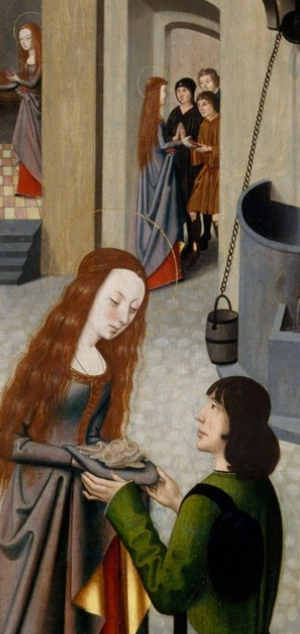
The Life and Miracles of Saint Godelieve (Detail)
Godelieve lived from approximately 1049 to 1070 near Bruges in present-day Belgium. In the early scenes, she is shown taking delicacies from her wealthy family’s kitchen and redistributing the food among the poor. She is accused of theft, but on two occasions angels intervene: once transforming the stolen food into wood chips, and again miraculously restoring the missing food to the banquet table. She is also portrayed as closely connected to animals. In one scene, she gently persuades a flock of crows to remain inside a small hut, protecting the surrounding fields from damage. Despite her goodness, she is accused of witchcraft and ultimately strangled by two of her husband’s servants, acting on the orders of both her husband and mother-in-law. In one of the final scenes, in the upper right portion of the altarpiece, her haloed ghost stands beside her body after it has been washed and placed back in her bed in an attempt to disguise the murder as a natural death. The drama continues after her death, when her husband’s daughter from a later marriage has her eyesight miraculously restored after washing her face in the well where Godelieve’s head had been submerged during the concealment of the crime.
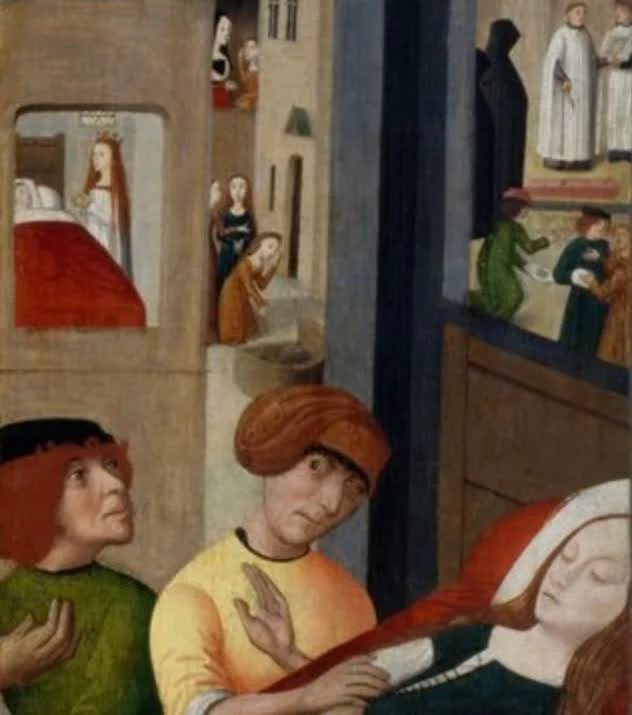
The Life and Miracles of Saint Godelieve (Detail)
This wonder-cabinet of a painting ticks all the boxes. You enter the architecture of the scene and are immediately seduced by bold reds and greens, blades of grass dotted with daisies, intricately rendered clothing patterns—striped pants, damask silks, opulent tapestries. Even the floor tiles are detailed in soothing, subdued pinks and greens. Each scene unfolds across seven panels, with elongated outer panels to suit the narrative flow of events. The overall atmosphere is opulent, dreamy, and fairy-tale-like.
The drama of the larger figures in the foreground gives way, with sustained attention, to events unfolding among the minutely rendered figures in the background. The intrigue and miracles that subvert and mysteriously articulate the story flesh out the life of Saint Godelieve, patroness of Flanders. The main characters repeat over and over again in variations of scale throughout the scenes and at times the painting becomes a labyrinth with story elements recurring and coming into and out of focus. The themes of feminine power and vulnerability, which remain hidden and alluded to in Gaskell’s large-format photographs, are placed explicitly on display in the altarpiece, as a reward for careful looking.
Let us not forget that this work is an altarpiece, meant to be viewed during Mass, perhaps only opened and visible on high holy days and celebrations. Otherwise, the altarpiece remains closed, its exterior panels depicting four dour saints and patrons dressed in muted tones, standing soldier-like along the ramparts of a grey castle wall, utterly lacking the vibrancy and opulence found within. The transformation between interior and exterior feels theatrical, like opening a secret chamber. It must have been a great excitement in the days before cinema, photography, and the widespread circulation of printed images— and especially rewarding to glimpse while otherwise dozing off during Sunday Mass. What a miracle, indeed, to enter the magical world depicted in the life of Saint Godelieve.
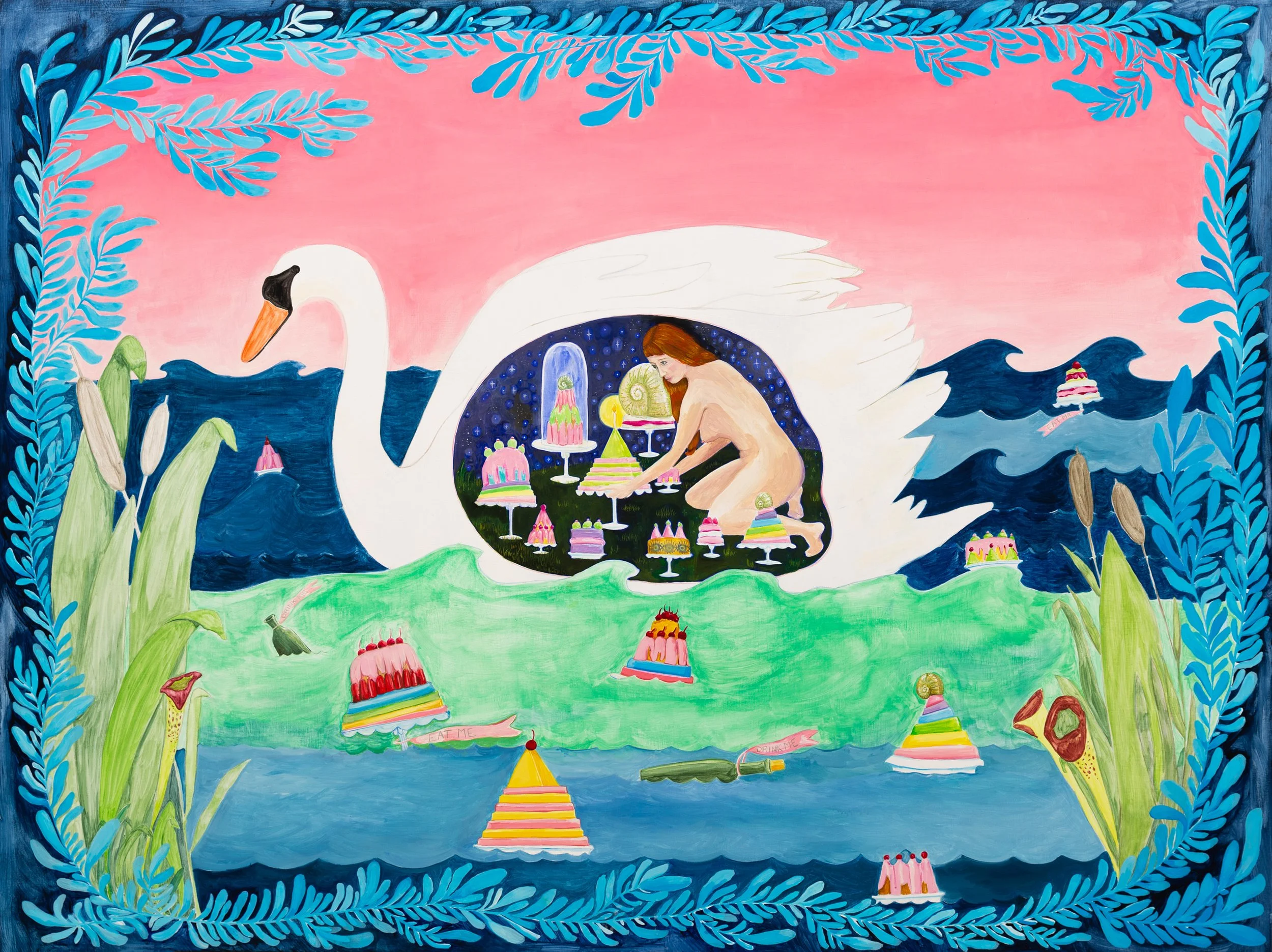
Dana Sherwood, Inside the Belly of the Swan, 2020, Oil on Panel, 36 x 48 inches
Dana Sherwood is an interdisciplinary artist, whose practice examines the relationship between humans and the natural world in order to better understand culture and behavior in the context of environmental change. Informed by intuitive, magical, and ancestral practices, her work challenges dominant Western narratives and seeks to foster dialogue with the more-than-human world through ecological and feminist perspectives. Her work has been exhibited internationally and is included in numerous collections including, The Metropolitan Museum of Art, The Florence Griswold Museum, and The Bunker Artspace among others.