
Yuka Nakamura on Takuto Kadokura
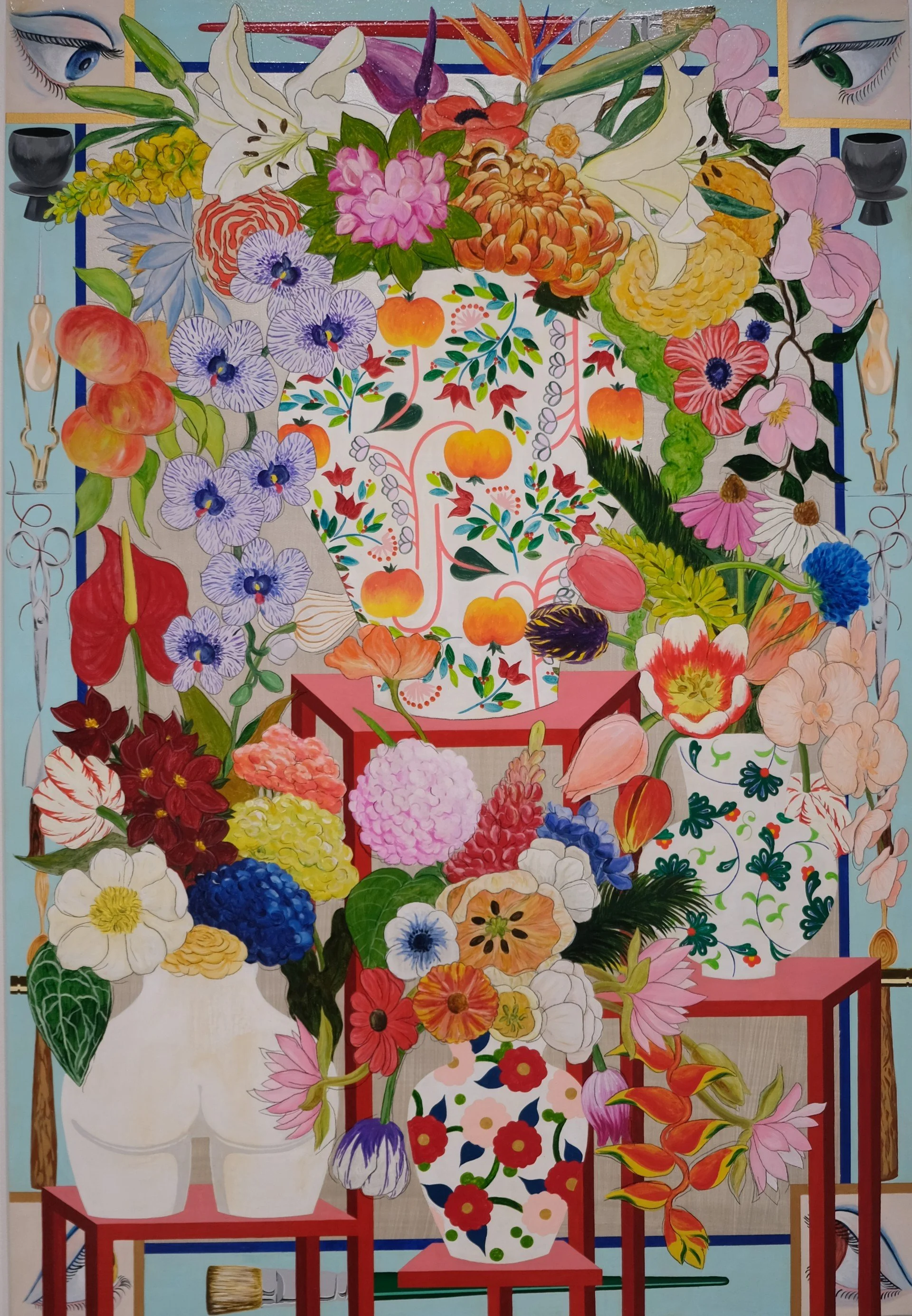
Takuto Kadokura, The Ideal Pot, 2026, Acrylic on canvas, 35.2 x 51.3 in (894mm×1303 mm)
Takuto Kadokura’s work employs subjects such as fruits and flowers that anyone can recognize as "beautiful" to express the fundamental difference between artificial and natural objects. His work THE IDEAL POT, exhibited at a solo exhibition held in Aoyama, Tokyo in March 2026, features graceful and supple curves in a floral composition that seems to convey elegance and generosity. Yet, simultaneously, the fact that these beautiful flowers are cut, filling the entire canvas, emphasizes their impermanence, much more than plants rooted in the earth. This sense of fleeting life reflects his thoughts on the differences between nature and the artificial, the distinctions we have recognized since ancient times.
"To me, cut flowers are foreign objects,” Kadokura shared with me in a recent interview. “I’ve always felt there’s something fundamentally strange about having flowers in a room. Plants that are supposed to grow from the earth are placed on stainless steel or wooden tables, existing there in an 'instant' state. I’ve always found that incredibly bizarre. Rather than looking at whether they are beautiful or not, I’m capturing that sense of extreme strangeness."
Before Kadokura was a painter, he was a designer, employed by the avant-garde fashion house Comme des Garçons. In that role, he learned the importance of startling innovation. He came to believe that art needs to introduce something new from the outside: to stir things up.
In his practice, he is always conscious of the boundary between the "ordinary world" and the "otherworld." Reflecting on his time at Comme des Garçons, he says:
"In my early 20s, I didn't truly understand how important it was to be 'new.' I didn't realize the weight of the 'newness' that Rei Kawakubo (Founder of Comme des Garçons) was talking about. Back in art school, I just wanted to create things that looked 'cool' by existing standards. But that wasn't enough. There is no value in anything other than creating the 'new' that lies one step beyond. Once you understand that value, you realize how difficult it is to bring something from zero to one. Anyone can make something that 8 out of 10 people think is good. But that won't do. You have to bet on something that only 2 out of 10 people might appreciate. It took me 11 years at Garçons to slowly realize how severe 'true creation' is—it was on a completely different level from what I had imagined as a student. During that time, I kept questioning what kind of creator I was. I realized that, while I’m not the type to lead the masses, I am someone who gives them a question mark."
Kadokura sees himself as a resident of that "otherworld" and identifies as a trickster. In our interview, he used a folktale as a metaphor to explain the societal function of unsettling art. The example he gives—the Namahage—is a traditional Japanese ritual featuring monstrous beings that threaten the tranquility of daily life. In this ancient story, children wail in terror. Yet, the adults believe the visitation of these fearsome monsters is essential to maintain the community. A visitor from another realm may seem to threaten our rich and secure lives, but perhaps their true role is to sharpen the silhouette of "life" against the unknown.
As a visitor from this otherworld, Kadokura expresses his vision through his cut flowers. By choosing flowers already severed from nature—destined to bloom beautifully for only a limited time—he does not present the organic beauty of plants. Instead, he brings an "unnatural beauty" and an "artificial intensity" into our peaceful daily existence.
Within Kadokura’s paintings, volumetric cut flowers coexist with flat floral patterns on a vase. At a glance, they seem to be the same. However, there is a profound dissonance between the once-living blooms and the static patterns on the pot. This friction between two-dimensional and three-dimensional elements mirrors the very environment we inhabit today—one where the real and the artificial are intricately blurred.
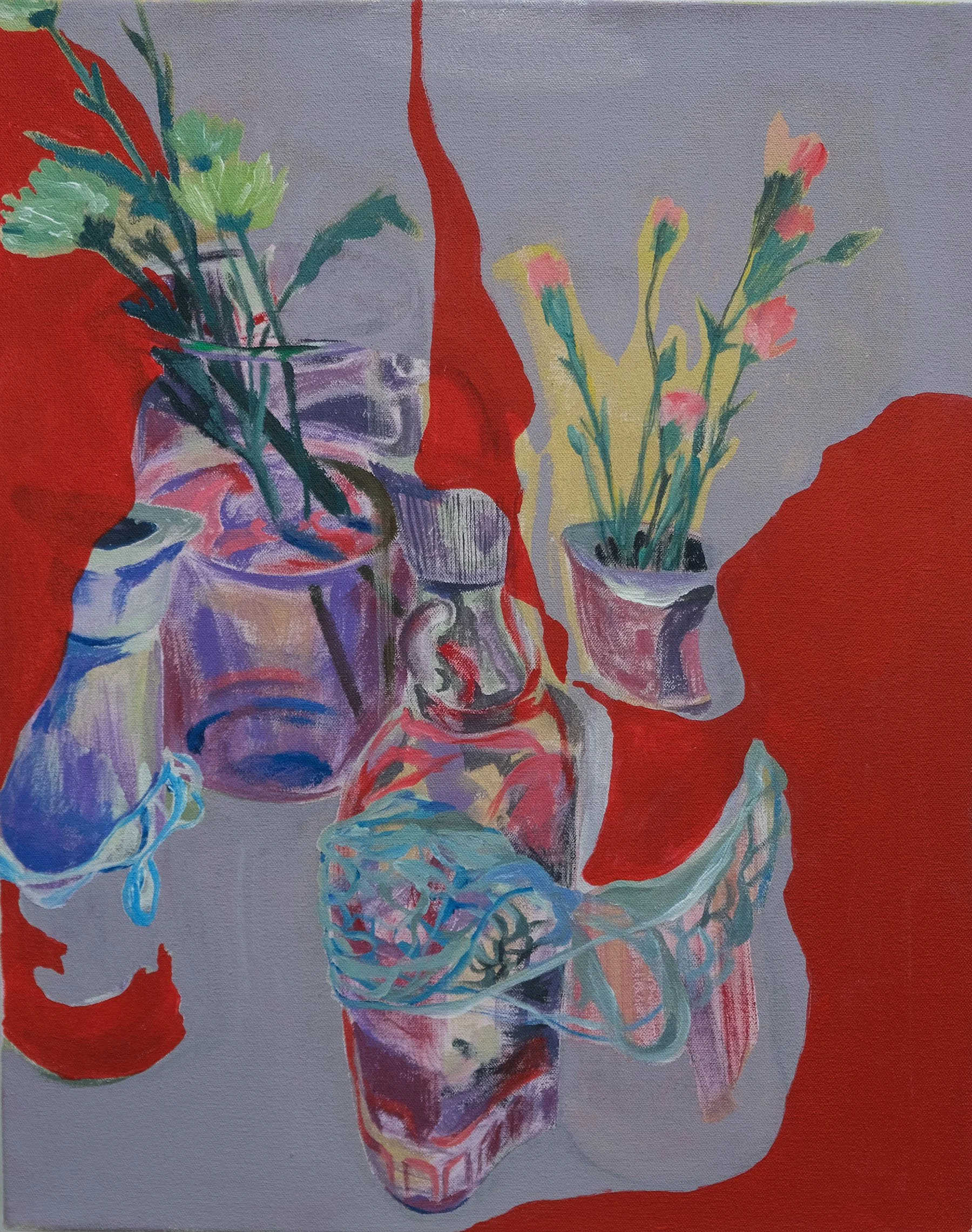
Yuka Nakamura, 2025 Spring, 2025, Acrylic on canvas,16 x 20 inches
YUKA NAKAMURA is an artist originally from Japan. She is a recent graduate of the MFA Fine Arts program at SUNY Purchase College. Before coming to New York, she spent several years working as an editor, which continues to influence her perspective on art. IG: @yukayamasaki