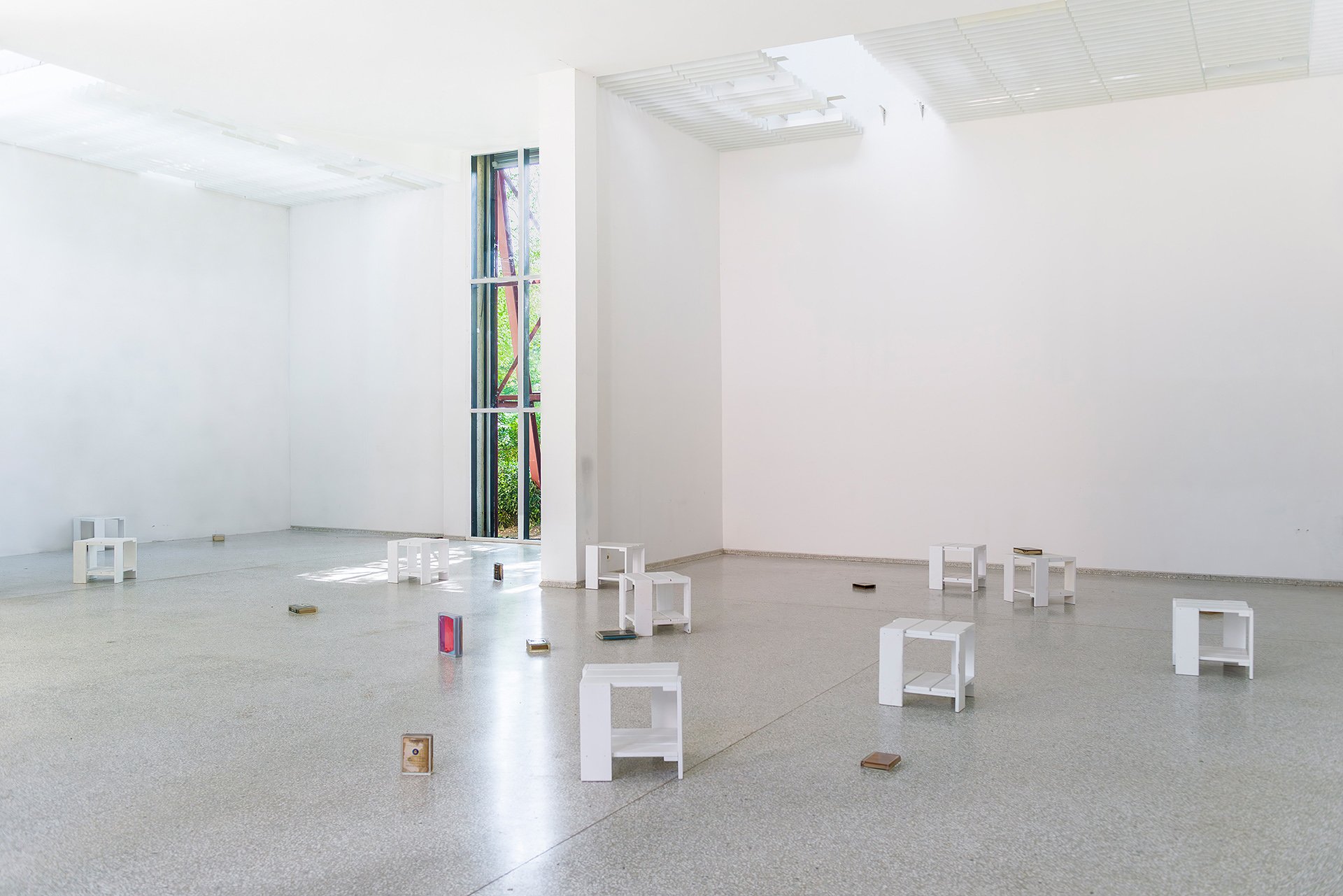
Dries Verhoeven, The Fortress, 2026. Interior view of the Dutch Pavilion, Venice Biennale.
Credit: Photograph by Willem Popelier, courtesy Mondriaan Fonds
The heavy doors of the Netherlands Pavilion closed, sealing us into a dark bunker. Then the light came up on a huge white room, with low white cubes scattered across the terrazzo floor and books lying among them, each one encased in a block of glass. There was no stage, so we all scrambled for what we hoped would be the best position. Then, for a long time, nothing happened. We looked at each other. Abruptly, a woman who had seemed to be just another visitor began making harsh, guttural sounds. An audience member seemed to be crying, or at least quite upset. Another put his head between his knees. When the performer, Lisen Pousette, needed a cube, she would move an audience member off it.
But she didn’t move me. She had already handed me one of the glass books, heavy as a brick, May You Live in Interesting Times, and then she sat down beside me on my cube and leaned on me for what felt like a very long time. I felt the weight of her body. Everyone was looking at me as I tried to work out the appropriate behavior. They didn’t know whether I was a member of the audience or one of the performers. Later she began to chant, love yourself, love yourself, and I felt she was directing it at me. A later line, chanted over and over, was: paint landscape. How did she know?
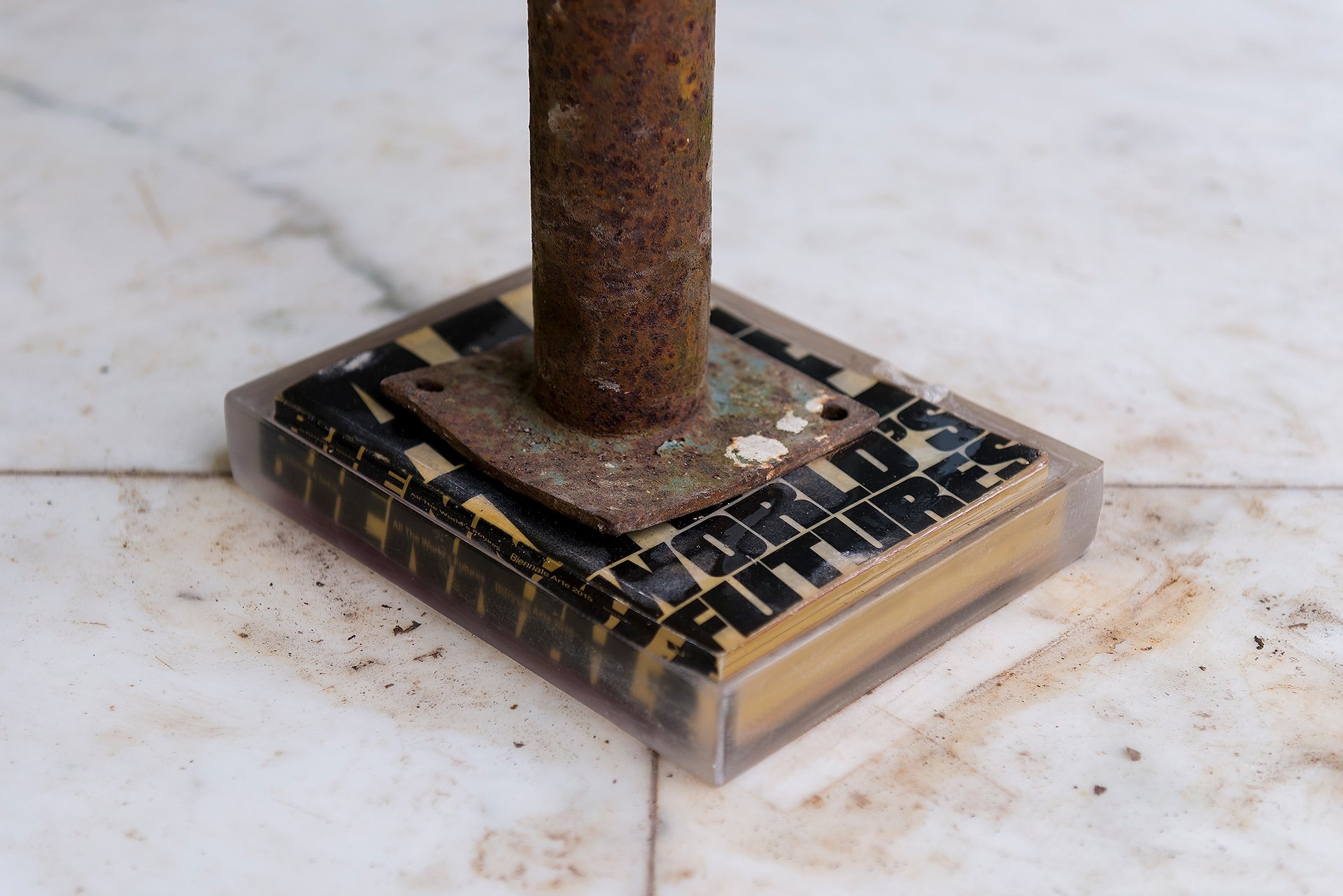
Dries Verhoeven, The Fortress, 2026. One of the Biennale catalogues encased in glass, Dutch Pavilion, Venice.
Credit: Photograph by Willem Popelier, courtesy Mondriaan Fonds
This was Dries Verhoeven’s The Fortress, a work about people sealing themselves off in uncertain times. After two months in the historic center of a largely abandoned Calabrian mountain village that my grandfather left a hundred years ago, where I was translating my family’s letters and painting the landscape, it felt strangely relevant. It is not easy returning to a village your family left, or discovering the truth about your past one letter at a time. I had come from the silence of a village of under five hundred people to spend a week back in the art world at the Biennale, but the glamour of the film festival was hard to resist. So two nights earlier I found myself crammed onto a boat to the Lido, headed for the Sala Grande to see Nicolas Pariser’s One Minute to Midnight. Of the hundreds of works I saw in Venice that week, this film and this performance have stayed with me.
One Minute to Midnight is a film in which almost nothing happens: a cup, a letter, and a lot of self-reflection. Léo, played by Melvil Poupaud, is forty-nine. His relationship is ending, and he learns that the father he never knew has died. Before going to Italy for the inheritance, he spends a few days in Paris taking stock, mostly of the women in his life, and of the pain he has caused them. He has built a life of not being able to connect with women, and he knows something is wrong. This is where I perked up.
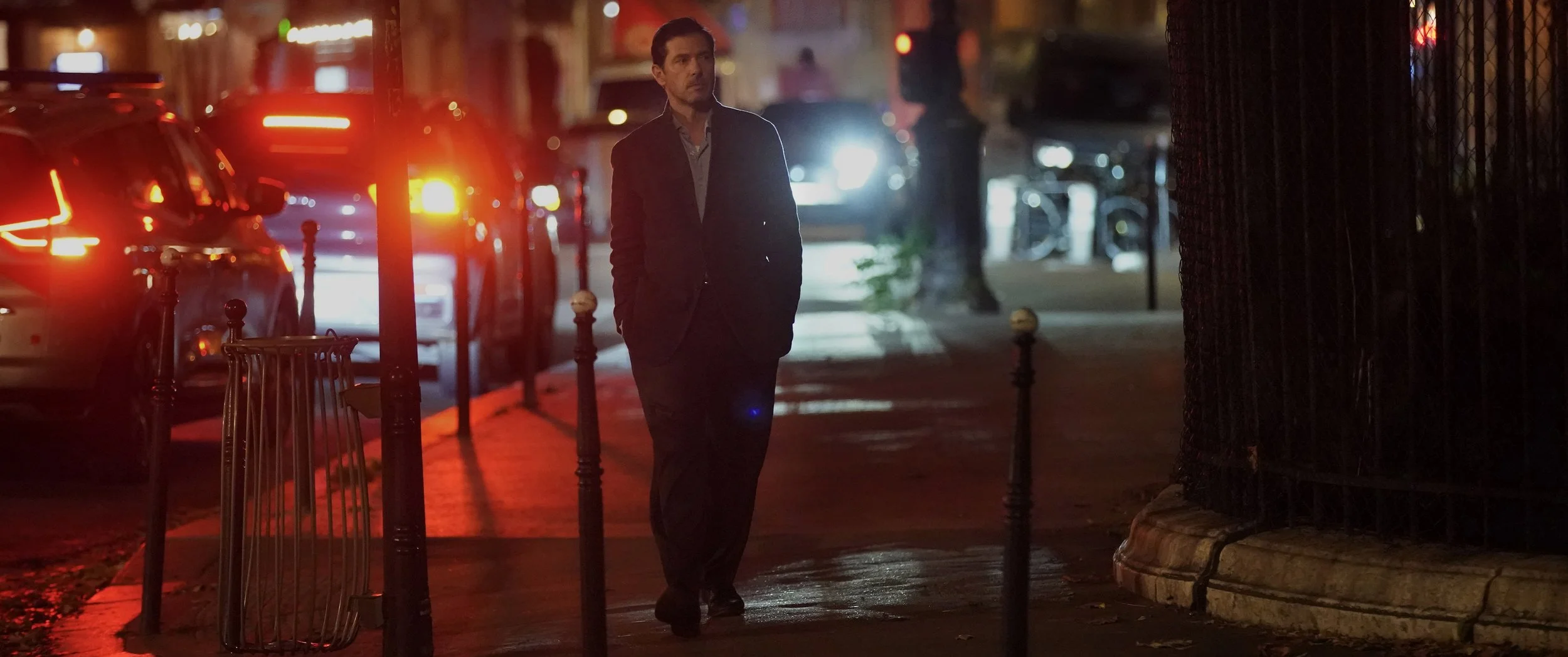
Melvil Poupaud as Léo in Nicolas Pariser’s One Minute to Midnight (Un peu avant minuit), 2026
Credit: Courtesy of Bizibi / Pyramide Films
A young actress I had never met was sitting next to me, and we were, more or less, Léo and his daughter Emma. In the film, Emma is an activist who isn’t interested in love, which might be partly her father’s doing. She has no interest in hurting anyone either, while he is still working out whom he hurt. The actress and I are from different times too. She is of the MeToo generation. I am of the generation where you just took it. We pointed things out to each other all through the film and dissected it waiting for the vaporetto back to San Marco. I loved her insight.
One of the women Léo visits is Tina (Golshifteh Farahani), whom he was once obsessed with. I was expecting a sexy reunion. Instead she tells him about a Japanese manga she is reading, in which a director, at ninety and at the end of his life, makes a transformative work. It is never too late. That was the detail the actress made sure I caught. She took it as a clue to the ending and convinced me that although the film doesn’t have a happy ending, it leaves the door open for one. Then Tina falls asleep on the sofa and Léo lies awake. She connects with him by disappearing and leaving him alone with an idea.
An old colleague of Léo’s is making a television series about the magazine they ran when they were young. Léo visits the set and watches young actors play his friends, and an unflattering version of himself. It’s eerie. Watching them, I recognized my own life as a portraitist. For me, the line between art and reality has always been blurry. I have painted more than three thousand portraits, and the relationship in the painting has always felt more real. When someone I have painted gains weight, loses their hair, or dies, it is hard for me.
Finally Léo, like me, makes a journey to Italy, a journey backwards. There, a half-sister he never knew notices the peculiar way he holds his cup, his thumb underneath the base as he raises it to his mouth, exactly the way their father did.
A thumb under a cup is the big event of the film. When I made my own journey backwards to Italy, family I had never known looked at my nose and connected it to a certain mountain. My mother’s family name is supposed to come from a rock up there. One day someone lined my profile up against the ridge to see if it matched. It did. That is my cup.
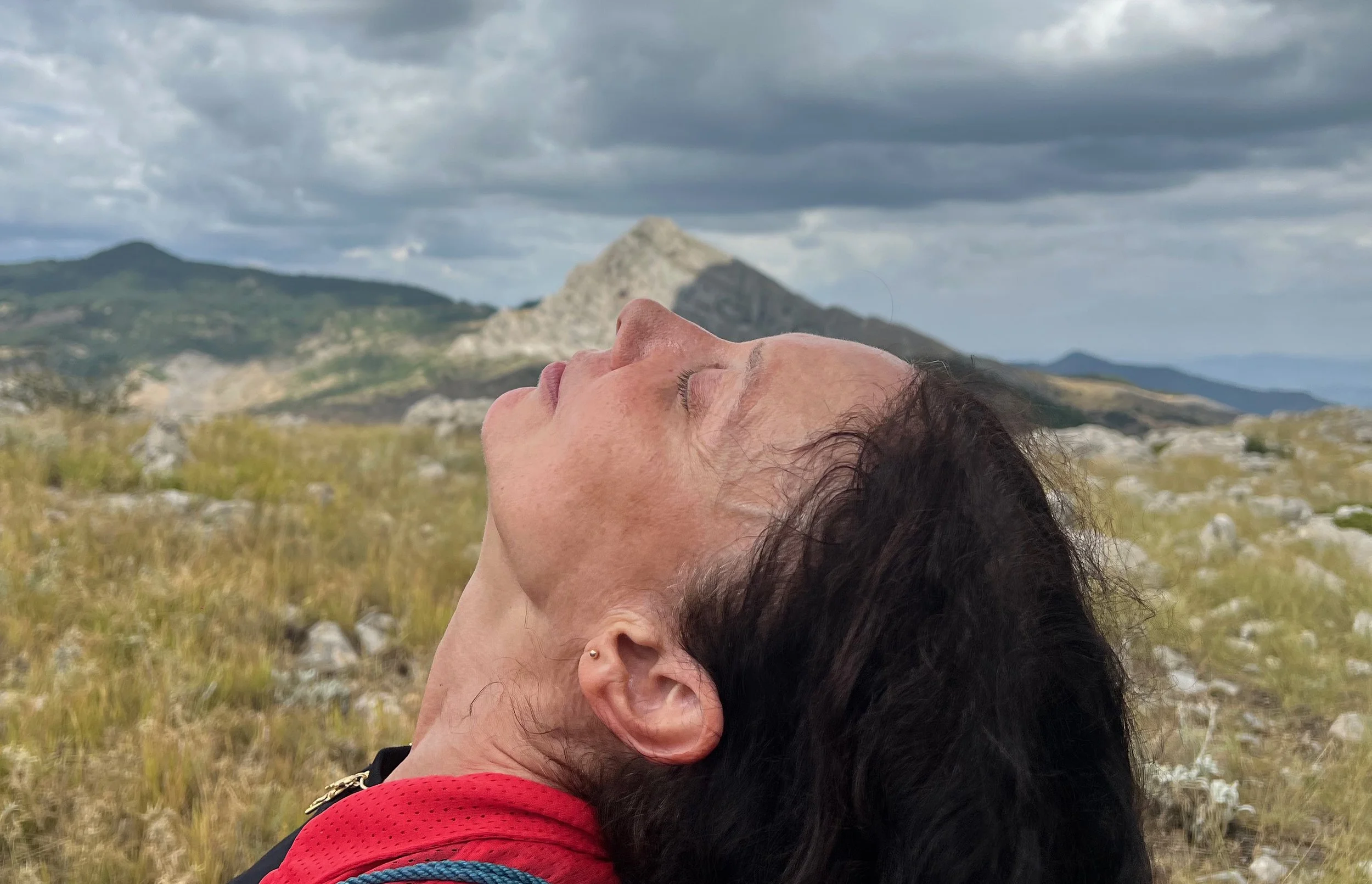
Brenda Zlamany lining her profile up against the ridge, Pollino, Calabria, 2026. Credit: Photograph by Rossana Bianchi
Then, in One Minute to Midnight, Léo’s half-sister gives him the letters his mother wrote to his father. In the last letter, written from the hospital near the end of her life, his mother looks at her son and begins to think that the great love his father described, which she had doubted, might have existed after all. Léo had always thought of himself as an accident, a child his mother kept because it was her last chance. He is still the child of a one-night stand. Nothing that happened changes. What might change is the belief that kept him isolated: that he was never loved. Without that belief, Léo could move forward differently. But the film doesn’t offer resolution.
When my mother died, my sister handed me a box of letters. It is my only inheritance. They went back and forth between my family in Calabria and my family in New York, from 1924 to 1980. The letters became a Fulbright project, and they led me to buy a house in my grandfather’s village.
We build a life on what we think our origin story means. The facts I’ve gathered about my family history are true. It’s the meaning I’m no longer sure of.
I ruined my mother’s first Christmas with her beautiful, “planned” first baby, my sister. Her water broke while she was putting the star on the tree, sending her to the hospital for the holiday. My sister, she said, never hugged her again because I came home. I was not planned. My mother was nursing my sister and didn’t think she could get pregnant (it was the fifties!). I was not named by my parents. My father wanted Noel and my mother wanted Dolores. While they argued and I screamed, the doctor who delivered me glanced at the newspaper on the table, open to the Brenda Starr comic, and broke up the fight: just name her Brenda. Not every parent would tell a child these stories. I left home at fourteen, and I have very few childhood memories.
So I read the letters looking for something that would tell me I am perhaps somebody else. Like Léo, I don’t appear until the last letters. In 1979 my mother drafts a letter to her cousin Nicola, a priest in Calabria I always called my uncle. Her own mother has died three months earlier and her heart is heavy, but she is arranging my visit. “Her plans have changed, she will come at Christmas.” She describes me in one line: “She doesn’t speak Italian, but she understands Spanish and French.” In the last letter in the box, Nicola tells her I arrived on Christmas Eve, that he took me to my grandfather’s village, and that I took many photographs, which I would show her when I got home. My origin story begins with my mother missing Christmas. The box ends with me arriving on Christmas Eve.
Nobody writes that they love me. My mother’s letter changes nothing about the childhood I barely remember. It only shows that I was there, a plan and then a visitor, in an exchange that makes me feel present. I keep rereading the letters, looking for something more.
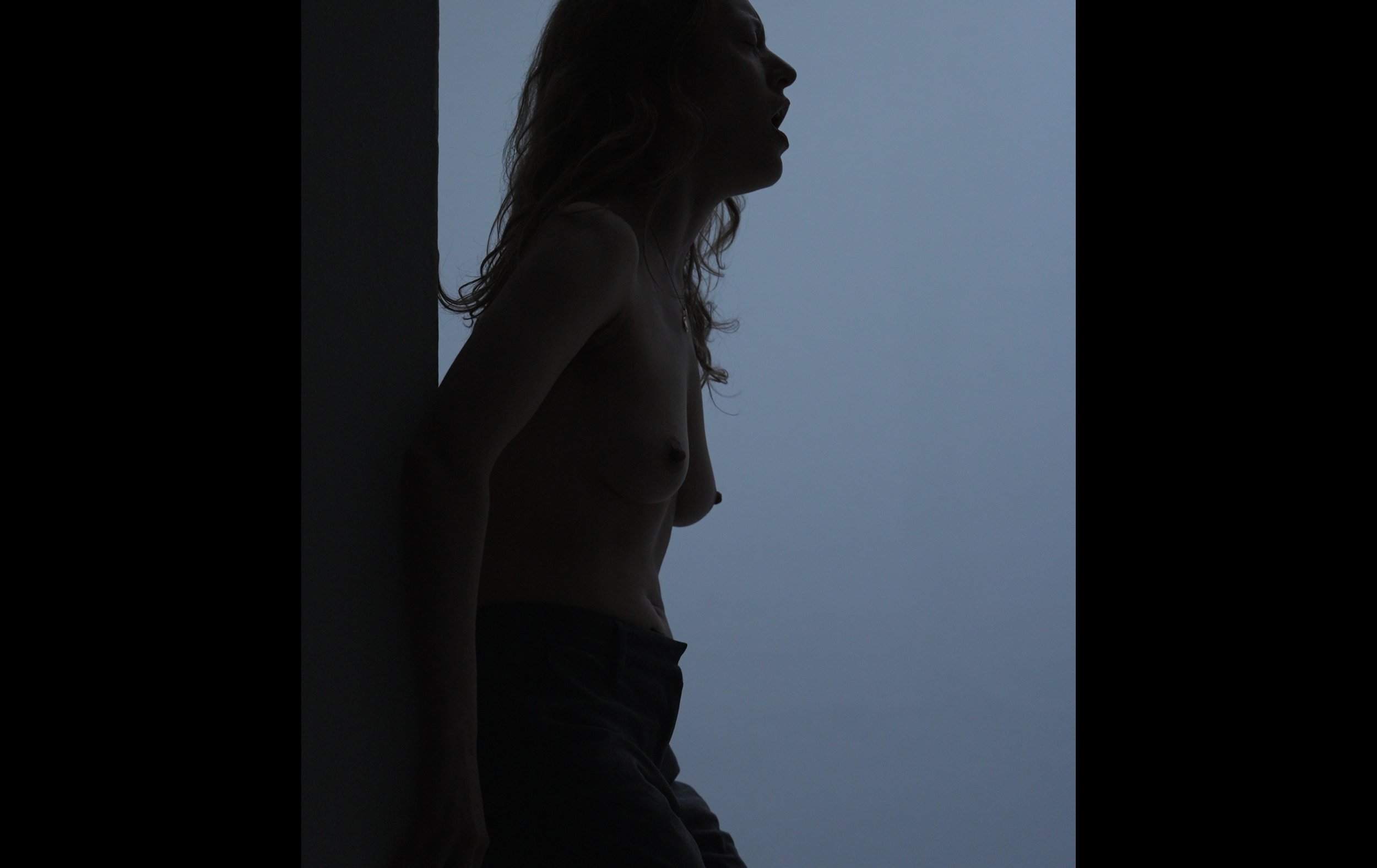
Dries Verhoeven, The Fortress, 2026. Performer Lisen Pousette, video still. Dutch Pavilion, Venice. Credit: Peteris Viksna, courtesy Studio Dries Verhoeven
I come back to Lisen Pousette, the woman who leaned on me in the locked room of the Netherlands Pavilion and, later, told me to love myself. After the performance I asked her why she chose to sit with me. She said she had a feeling. The piece is improvised around each audience. They say “paint landscape” at every performance, to whoever is in the room, and she couldn’t have known that I had spent the summer painting the mountain that matches my nose, trying to find a sense of belonging.
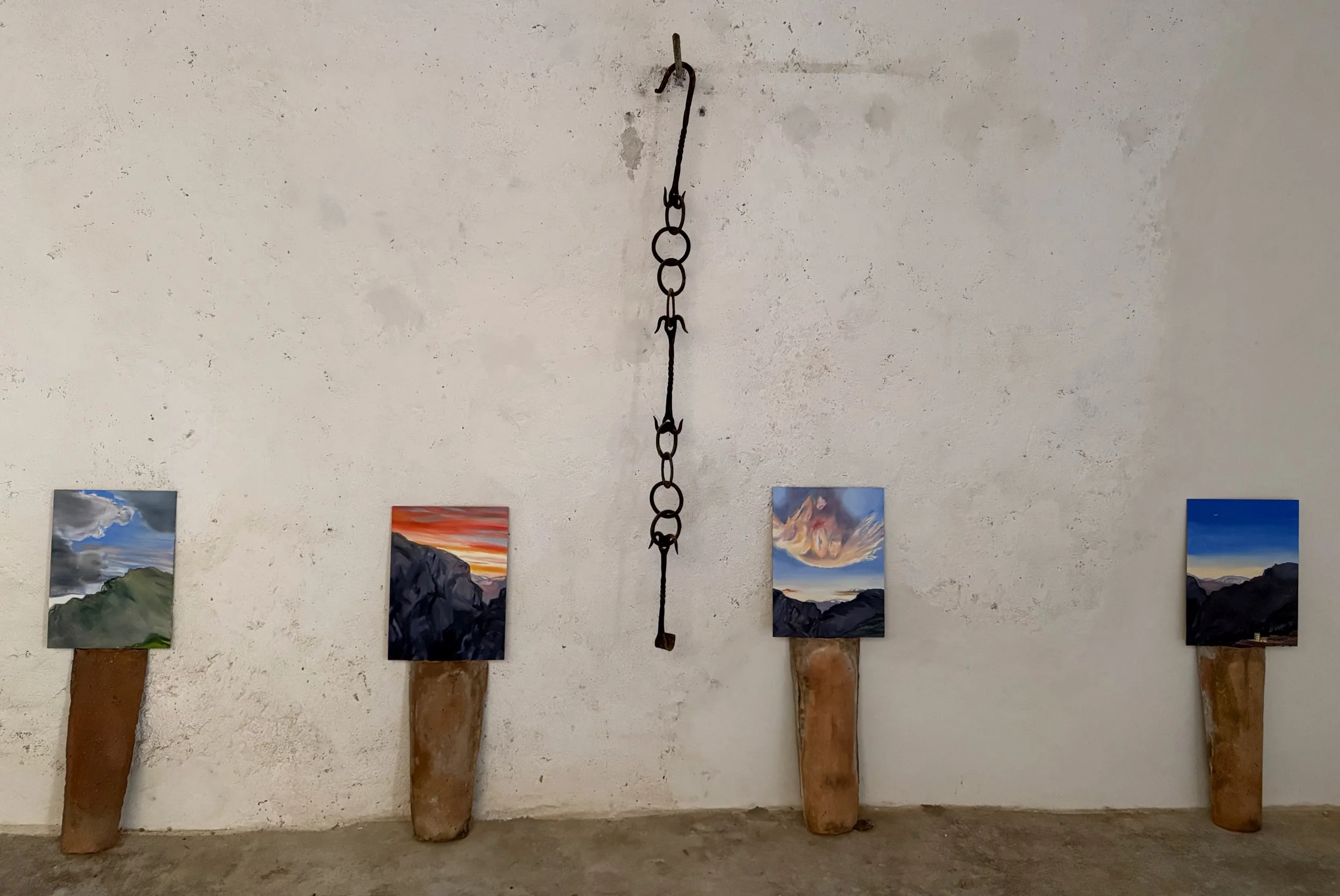
Brenda Zlamany, Calabria landscapes, 2026, oil paintings installed in the artist’s studio, San Lorenzo Bellizzi. Credit: Courtesy of Brenda Zlamany
I bury myself in my work so I don’t have to deal with whether or not an “unloved” child can love herself. This summer I painted that landscape every day, as a discipline, and found myself in it. At moments, I came to love myself through the painting. I’m a single parent by choice. It is just my daughter and me. In the village I suddenly have relatives, so many of them, who are genuinely loving and who see me as part of the fabric. It is a beautiful thing and an extremely terrifying thing. For the first time in my life I was afraid to paint people.
After Venice I painted the oldest woman in the village. She is a hundred and two and blind. I held her hand the whole time, with my brushes in it, so she could feel them and know what was going on. She couldn’t see the portrait. It was electric. In the photograph from that day, I am leaning my head against hers.
At the end of the movie Léo has a sister he never knew, and a letter from his mother. I have my letter. The film doesn’t say what his says. But mine says I wasn’t invisible. What will I do with that? I don’t know.
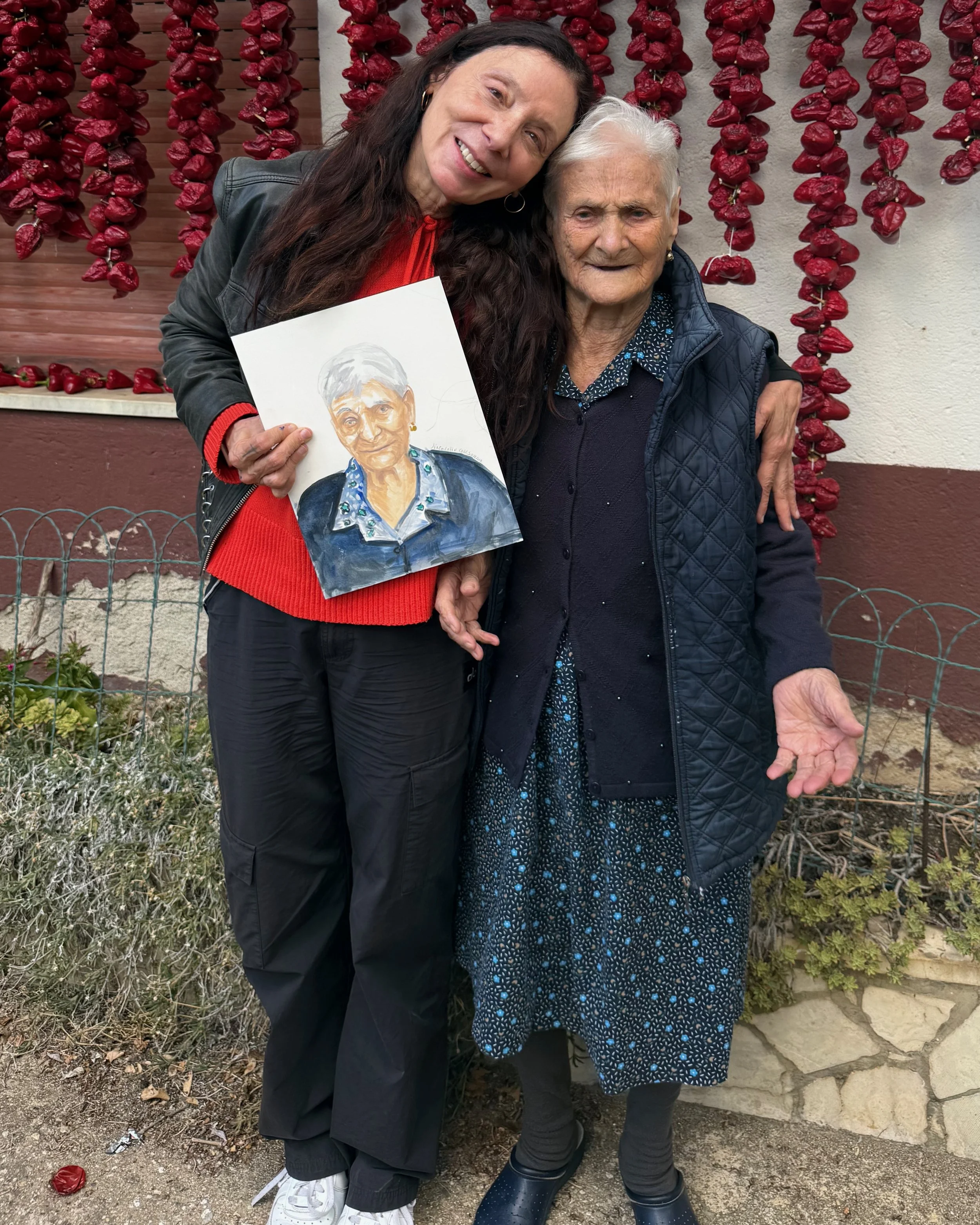
Brenda Zlamany with Gelsomina Nicoletti, 102, and her finished portrait, San Lorenzo Bellizzi, Calabria, 2026. Credit: Photograph by Lena Armentano
Brenda Zlamany is a painter who divides her time between Brooklyn and Calabria, and the creator of The Itinerant Portraitist, an ongoing global project spanning more than 3,000 portraits, with work exhibited at the Brooklyn Museum, the Taipei Museum of Contemporary Art, and the National Portrait Galleries in London and Washington, DC. A two-time Fulbright Scholar, she is developing 108 Letters, a project built on her family’s correspondence between Calabria and New York.