Suzanne Stryk on Charles Goolsby
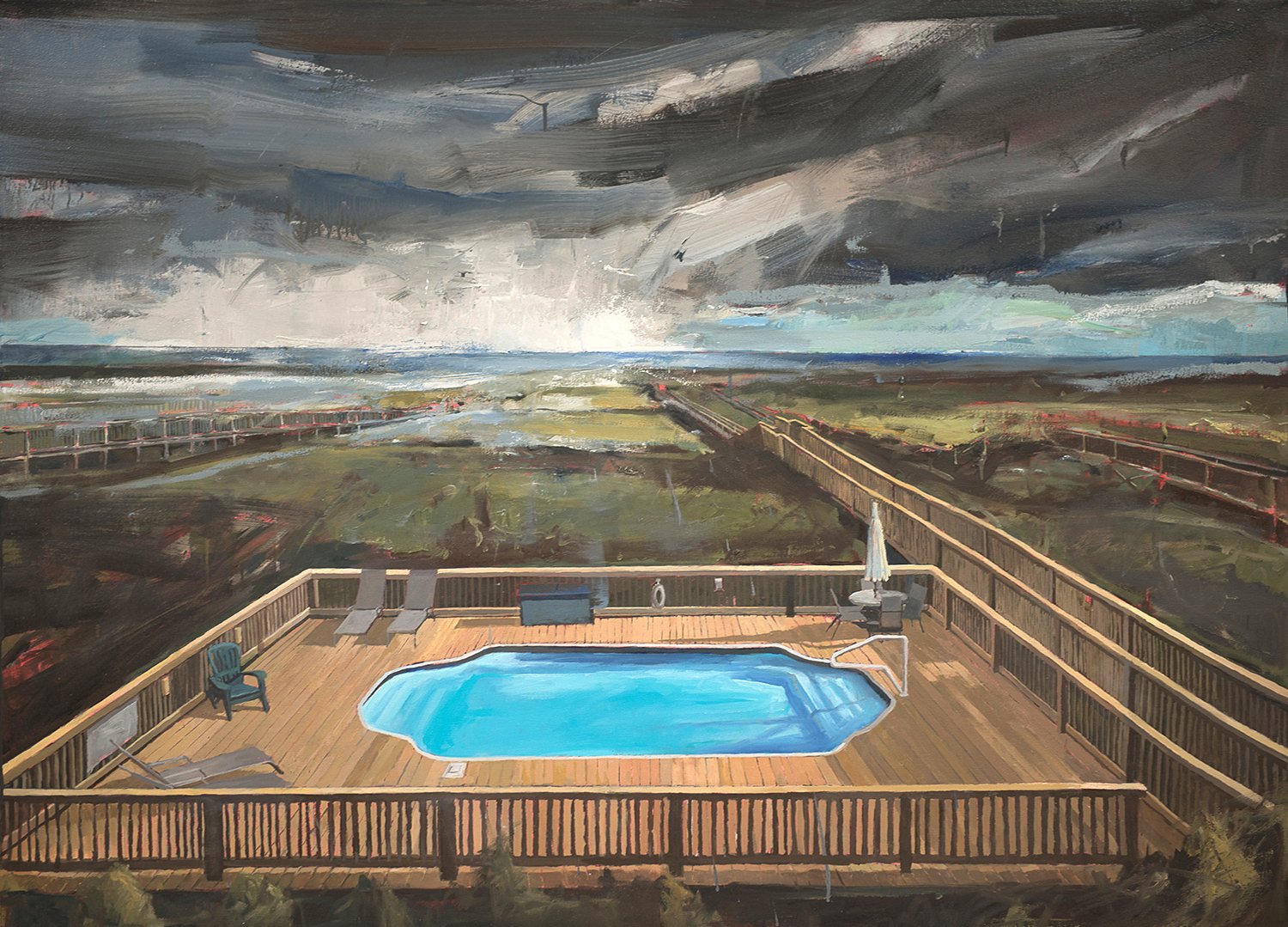
Charles Goolsby, Beach Front, 2024, Oil on canvas, 44 x 60 inches
Points of Departure: Recent Landscapes by Charles Goolsby
William King Museum of Art, Abingdon, VA April 2-August 3, 2026
I’m standing before a large Charles Goolsby painting with a swimming pool smack in the lower center, reminding me of an enormous aqua-blue eye staring blindly at a wild gray sky. No plein-air painting, this, though its point of departure may be a real place. In “Beach Front,” the lounge chairs sit empty, the seashore distant, and the mood is chlorinated and salty. It evokes both our unsettling relationship to the land and our human lives as we seek safety in an unpredictable, indifferent world. The brushwork is masterful—but wait: the pool section, tightly fenced in, is rendered with precision, while slashes of gooey oil paint conjure salt marsh and sky. And herein lies a truth about our lives: we yearn for control, however chimerical, in a volatile world.
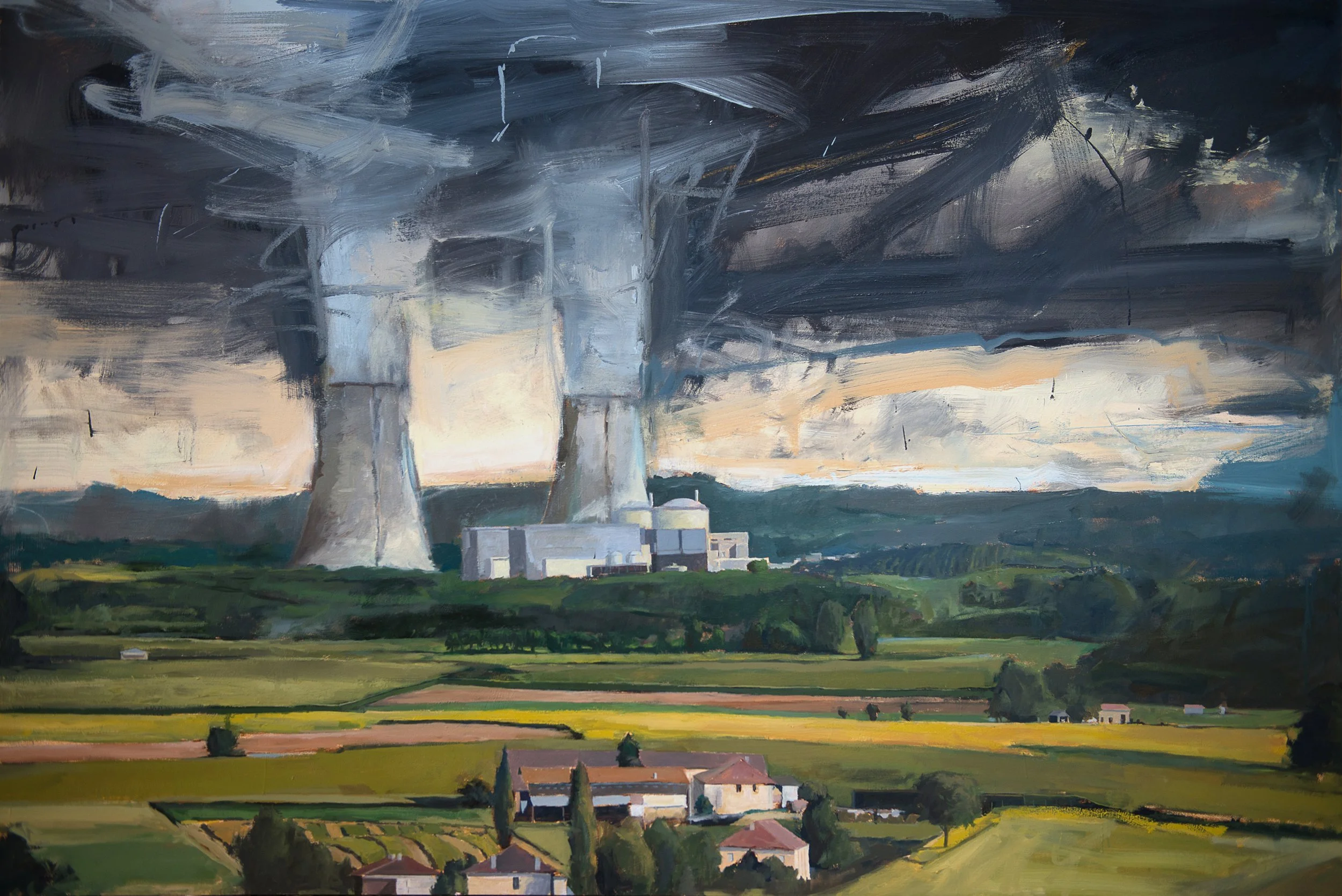
Charles Goolsby, Golfech Towers, 2026, Oil on canvas, 48 x 72 inches
A sunny Provence landscape stretches across the painting “Golfech Towers,” where fields of green and gold, browns of tilled earth, and tall poplars serenely punctuate a compound of commonplace white dwellings. Yet towering over this rural peace loom two nuclear power plant towers, belching steam into a tumultuous sky. This is an icon of modernity: we want both our cozy organic lives and the flick of a switch.
And in “Early Departure,” a colonnade of condominiums stands off-center, tidy and gray, the kind one sees everywhere, plunked onto the land as if in a model-train town. But here the condos border an acrid yellow-green grassy lawn lit by artificial porch and streetlights, suggesting disquiet in this domestic scene; one imagines occupants asleep, dreaming of safety while the twilight sun cracks like a wound.
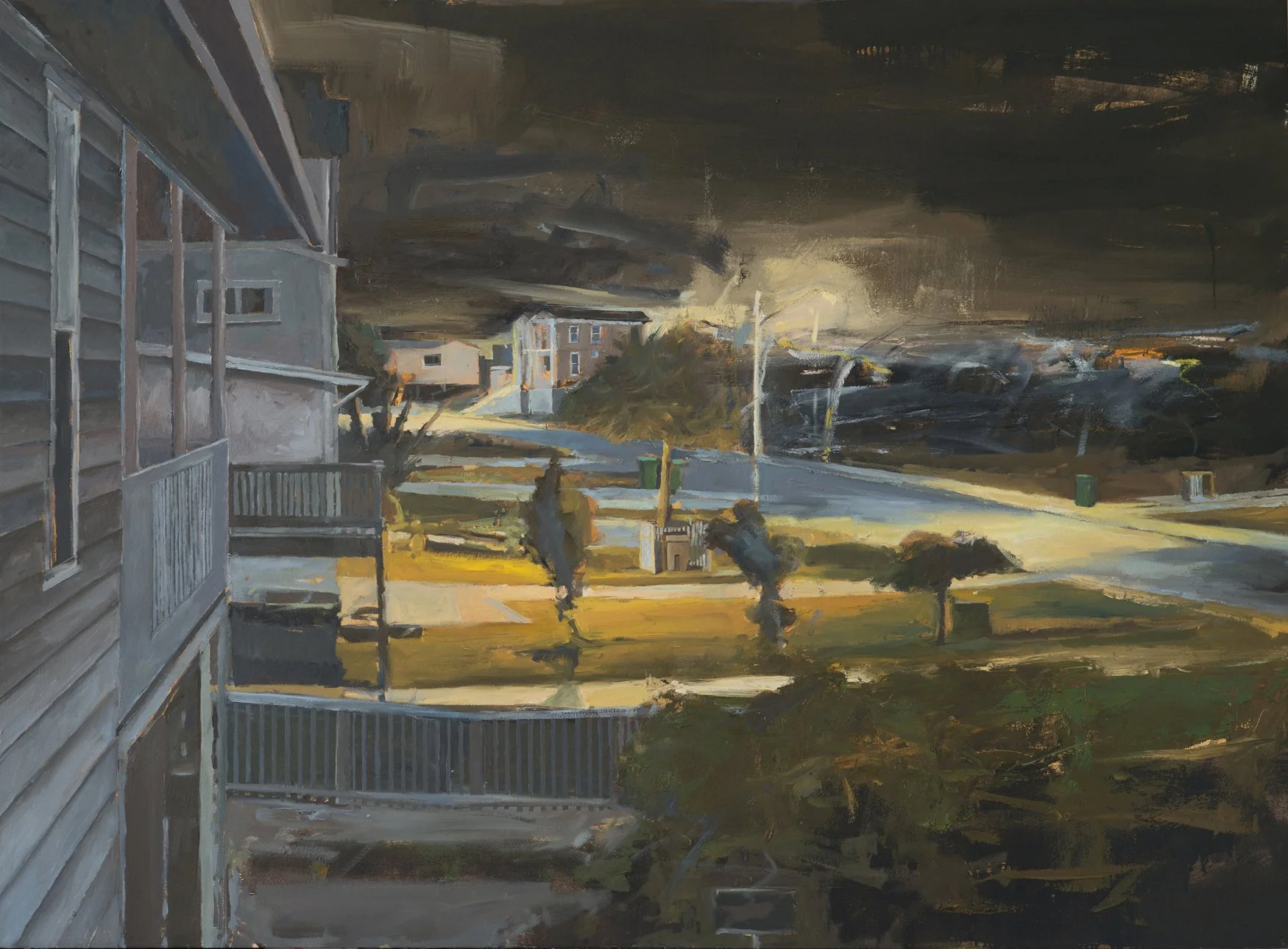
Charles Goolsby, Early Departure, 2020, Oil on canvas, 44 x 60 inches
Landscapes rarely make me aware of both outer and inner realms. But these landscapes evoke a sense of isolation and a need for security amid wildness—both physical and psychological. And it’s all in what the artist chooses to paint, the brushwork, and a personal palette—those grays, the pink underpainting peeking out, and the odd yellows are the characters in Goolsby’s drama. The images wouldn't be nearly as powerful if purely abstract; the point of departure packs the punch. And the punch? Take a dip in the chlorinated pool or risk the riptide, the shark, the wave rushing over us in a glorious but dangerous gush.
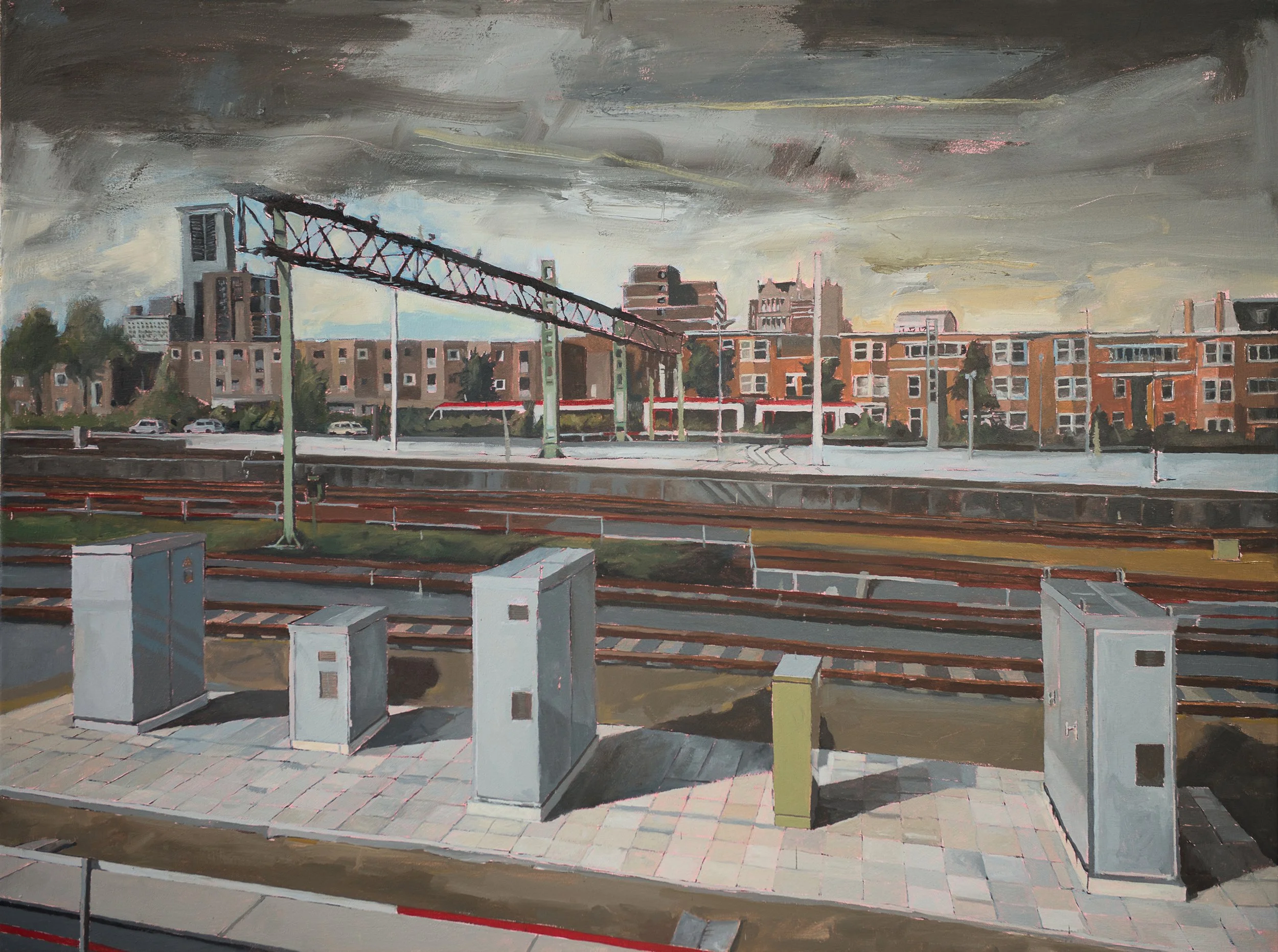
Charles Goolsby, The Hague Platform II, 2026, Oil on canvas, 36 x 48 inches
Of all Goolsby’s powerful urban landscapes in the exhibit, I’m stuck on “The Hague: Platform II,” where five rectangular containers line the foreground. I smile at the thought of them as a hybrid between Judd's minimalist steel boxes and Delvaux’s women. But I’m not really amused. I view them as stand-ins for isolated individuals who keep their distance, each waiting, each casting a separate shadow. I shift my gaze, following the strong horizontals of rails and rows of flats, cut by the dynamic one-point perspective of a signal bridge. Then I circle back to the boxes and notice that only one is mustard yellow, which both activates the grouping compositionally and suggests an outsider.
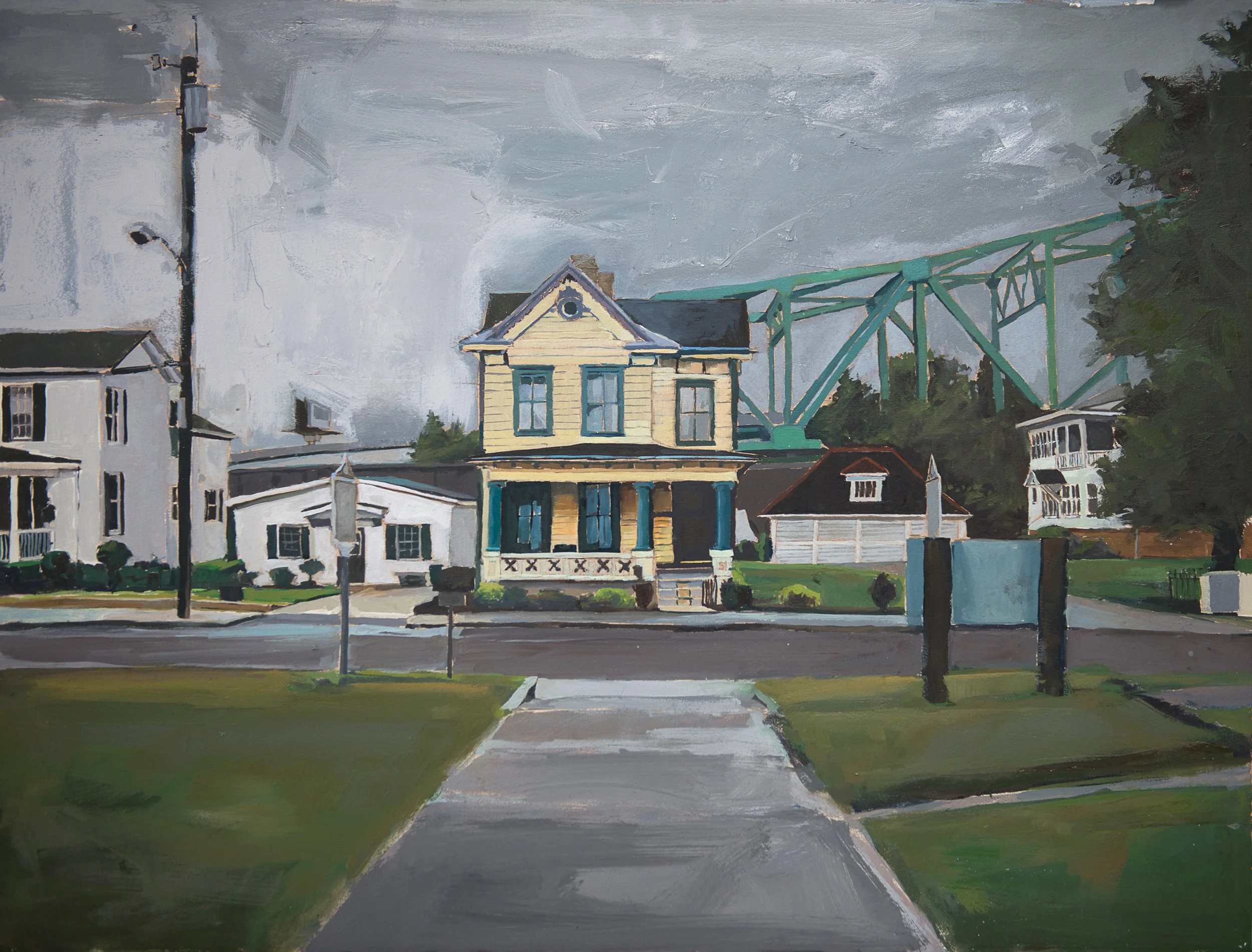
Charles Goolsby, Point Pleasant II, 2026, Oil on paper, 21 x 38 inches
When the artist paints what might at first seem a small-town descriptive image, the dam of mimesis breaks with a slash of pungent color, a wild sky, or the intrusion of a discordant element, as in “Point Pleasant II,” where a steel-truss bridge collides visually with a little clapboard house. But, in others, it may be as subtle as an empty picnic table, a tilted pole, a fire hydrant, or a scrape/drip of paint. I’m reminded of how Edward Hopper suggests mood simply by the way light rakes across the grass or illuminates the side of a house. Yes, this.
Artists’ sketchbooks often reveal the artist’s process. Here, Goolsby’s source photos and sketchbooks on display showcase his masterful gestural pencil ink and marker drawings and transformation of the source materials into the final work.
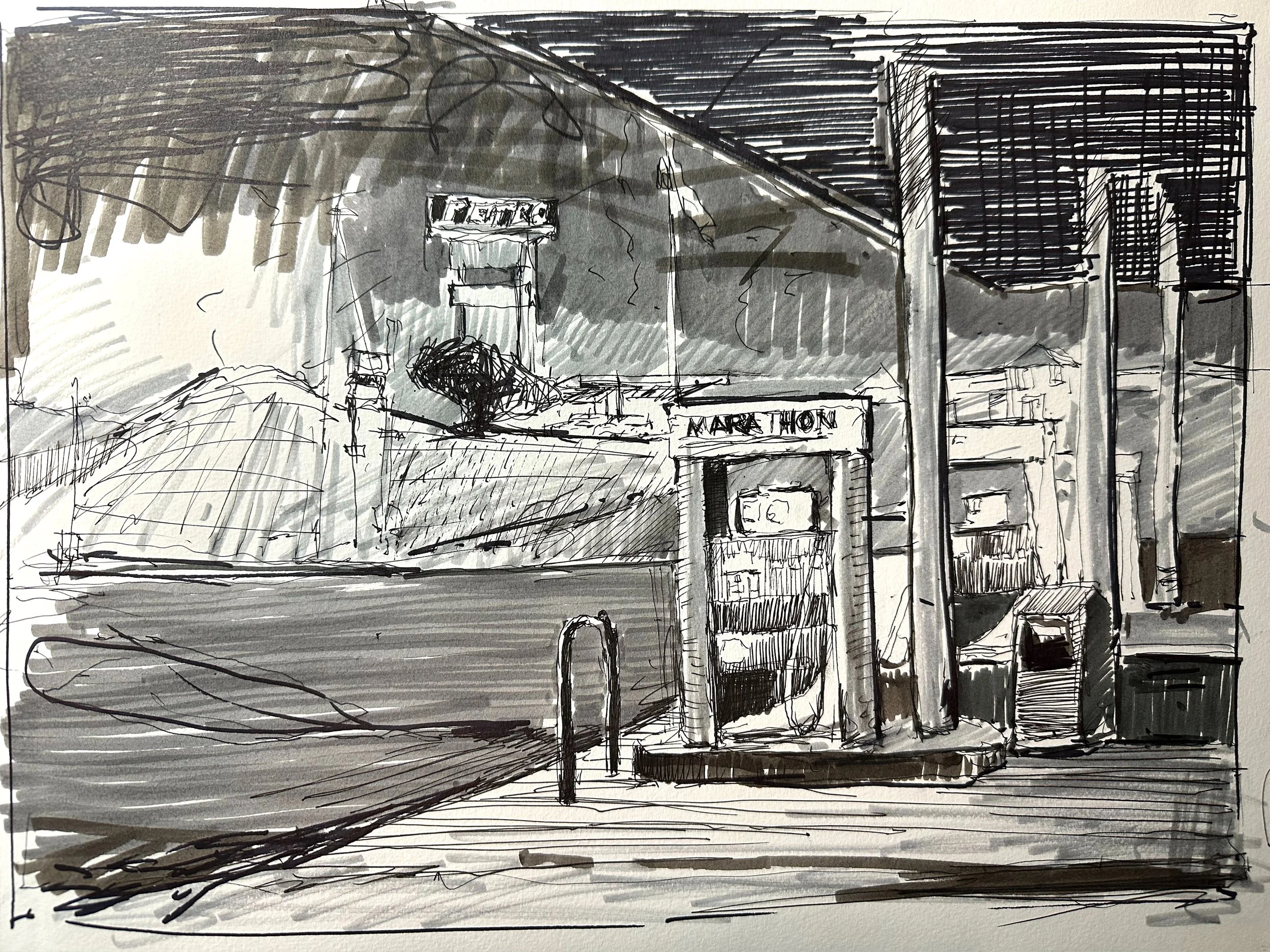
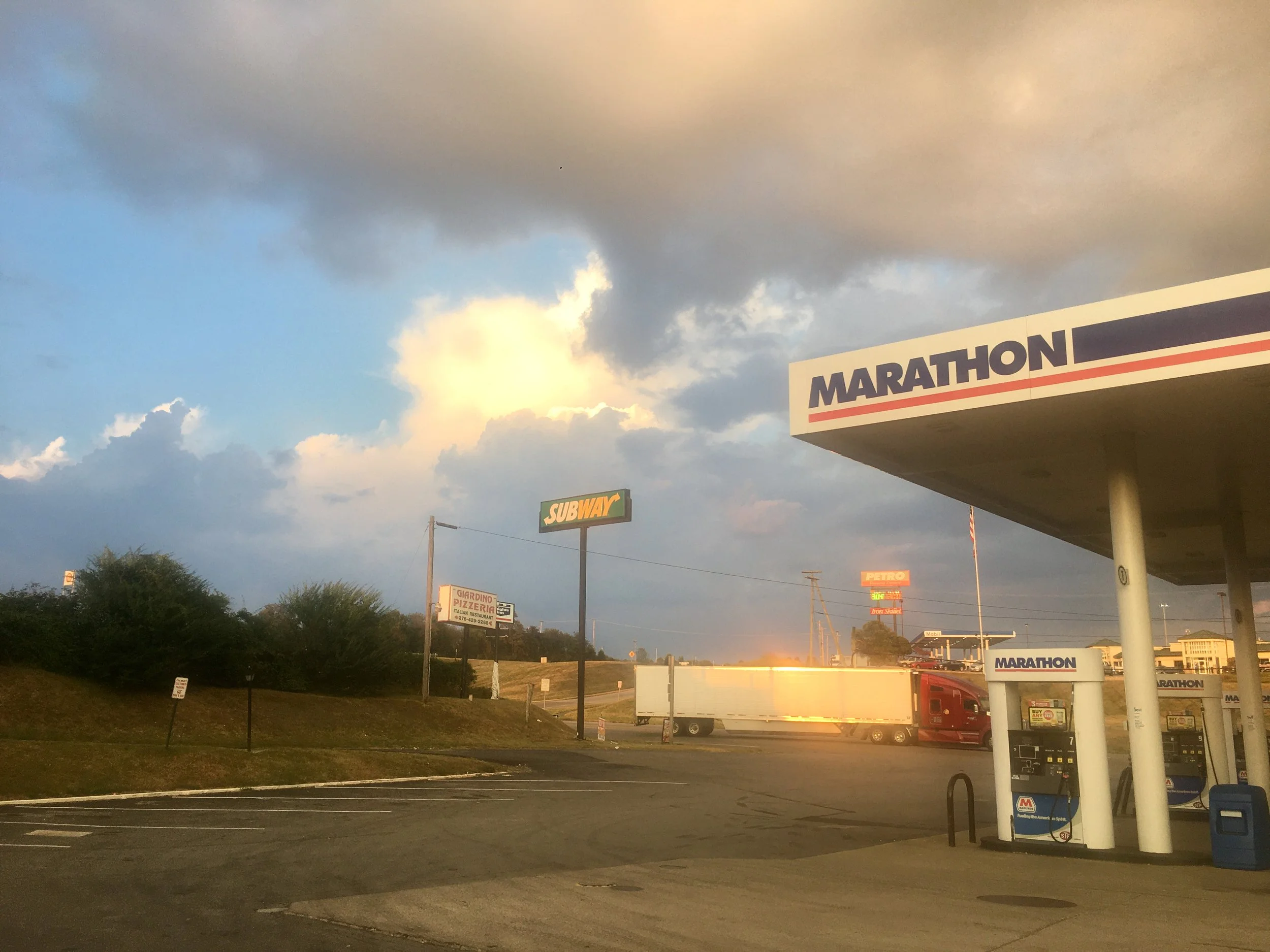
Charles Goolsby, Sketch and Source Photo, Installation in Points of Departure: Recent Landscapes by Charles Goolsby at the William King Museum of Art, Abingdon, VA
As I circle the gallery now, revisiting some paintings, I wonder: Why are these images so magnetic, so cathartic? There isn’t solace in them, but there is a kind of—how can I say this?—connection, a telepathic recognition that we all share this state of jostling between poles. Domestic and wild. Safety and risk. Control and spontaneity. Ultimately, I feel a visceral reconciliation of energy and calm, of power and subtlety. The images have stirred heightened awareness and sensation in me. And that’s good, so good.
Before leaving, I wander back to the swimming pool, its Cyclops eye staring into the uncaring void. No one inhabits the landscape, yet I feel I am smack-dab in it, fully alive as I stare into my own contradictions.
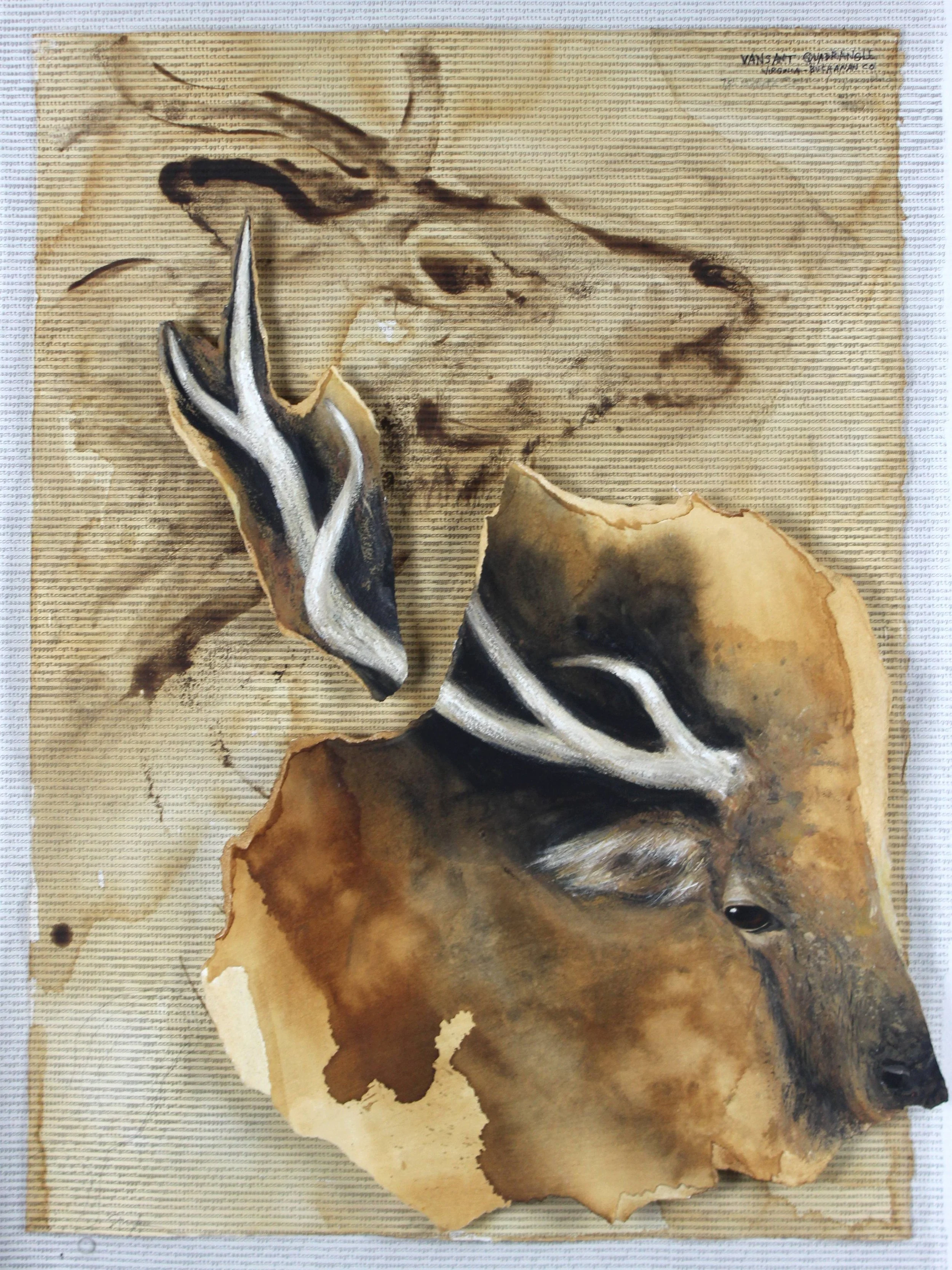
Suzanne Stryk, Restoration (Elk), 2025, mixed media assemblage (walnut ink and acrylic on paper, elk genome printed on film, pencil), 28 x 21 inches
Suzanne Stryk is an artist and author whose conceptual nature paintings and assemblages have been exhibited in solo shows across the country, including at The National Academy of Sciences (DC), The Taubman Museum of Art (VA), and The Illinois Institute of Art (Chicago). She has received a George Sugarman Foundation grant and a fellowship from the Virginia Commission for the Arts. In 2022, her book The Middle of Somewhere: An Artist Explores the Nature of Virginia was published by Trinity University Press.